Author: xerkss

  • Tempted to Touch

    Tempted to Touch

    Close your eyes for a moment. You’re standing alone in the massive gallery at the Louvre. There, with no one between you and a 500- year old masterpiece but the quiet. Keeping your hands in place, securely behind your back, you lean in to study the colors and textures. Art is integral to the human experience. What would it take to reach out your hand, inch your way closer, cross over the flimsy barrier and steal a moment.

    Author and professor Fiona Candlin, is not at all unfamiliar with these secret moments. Spending many years investigating the motivations behind why visitors touch exhibits without permission.

    She examines what visitors choose to touch, and how these unauthorized touches make them feel. Consequently, her findings show that this type of rule-breaking is just another part of the museum-going experience. Throughout observation at the British Museum for a report published in The Senses and Society Journal, a security guard told Candlin, “You stop a hundred people touching and there are 200 more … It’s like trying to turn back the sea.”

    Closer inspection
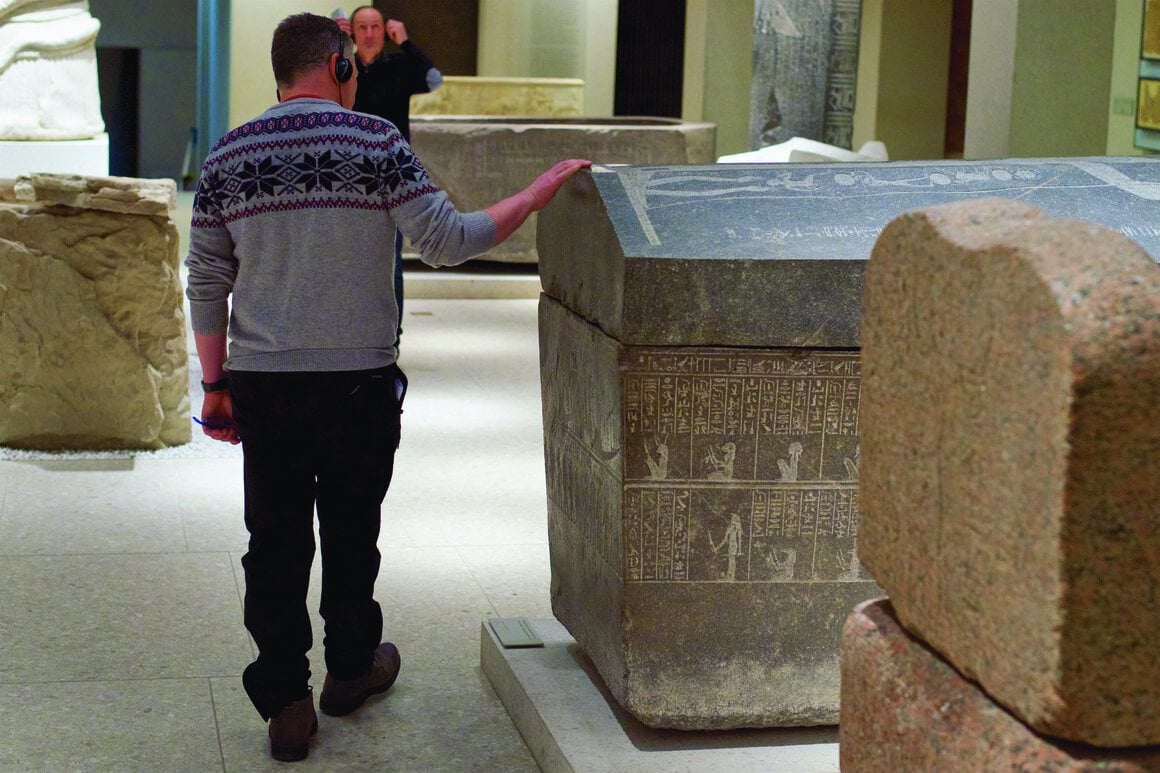
    A man runs his hand along a carved sarcophagus at the Neues Museum in Berlin.
    Neues Museum, Berlin

    Museums are, for the most part, quiet places. Visitors walk quietly from gallery to gallery and contemplate art from a distance. However, Simon Hayhoe, a lecturer at the University of Bath who specializes in art education and disability, suggests that the desire to close that distance is not uncommon. Candlin and Hayhoe both agree that the desire to inspect the authenticity of ancient pieces is a primary goal of those of us – looking to break the rules and reach out.

    “There can be a real blur between museums and experiences and theme parks and waxworks. Often if you have really big objects on display. If you think about going into the Egyptian galleries in the British Museum or the Met. Some people can’t believe you would put real things on display without glass around them. They’re not quite sure and they figure if they touch it, they can make an assessment,” Candlin said. “Part of that inspection is to confirm authenticity.

    “So there is a sense of power there as well. There is a sense of you are not allowed anywhere near this painting. Because it’s imbued with God, it’s imbued with power, it’s imbued with something you’re never going to be close to.” Candlins’ research illuminates the many reasons why museum visitors succumb to the temptation. One of which is so intrinsic to our need for knowledge.

    An emotional connection

    The Winged Victory of Samothrace, also called the Nike of Samothrace in the Louvre museum in Paris. Visitors surround the statue.
    The Winged Victory of Samothrace, 2nd Century BC.

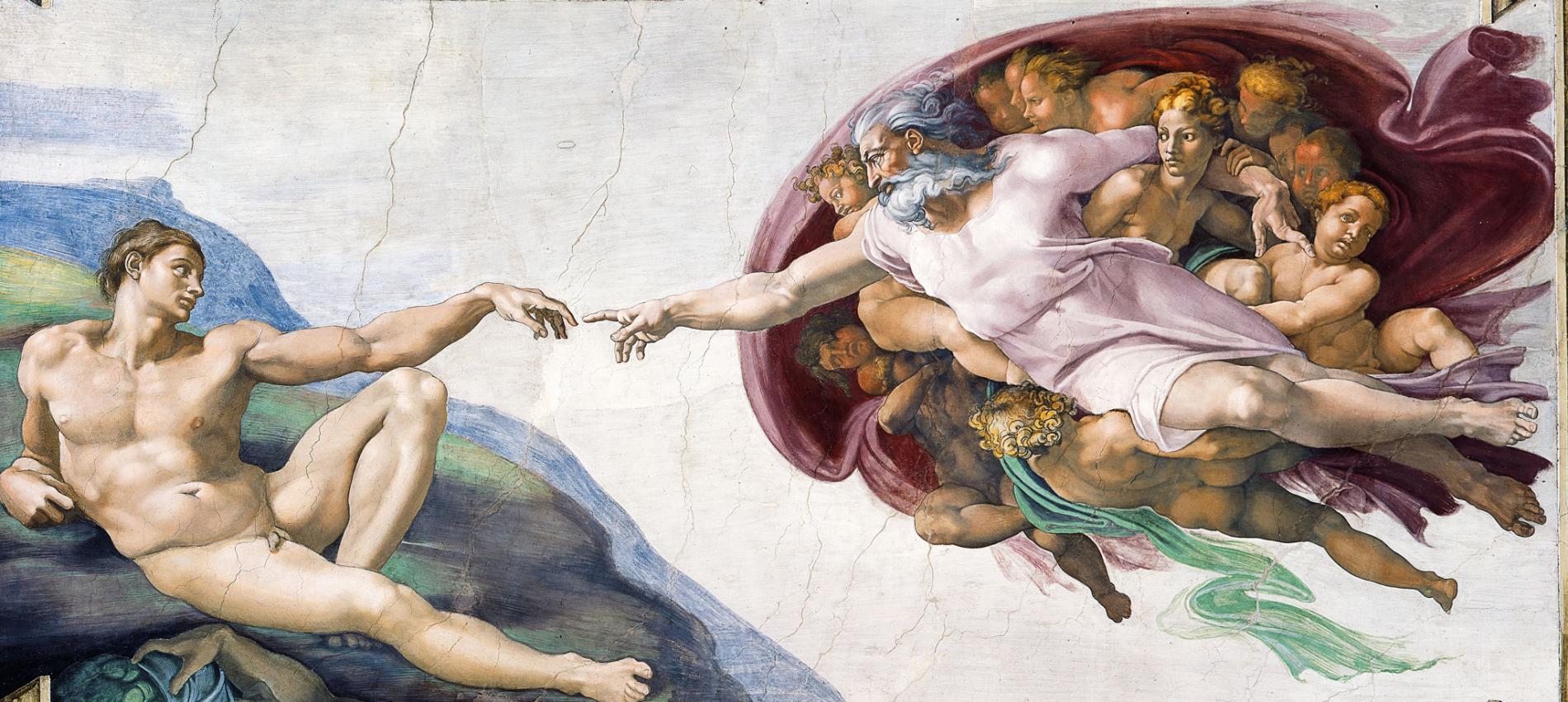
    Touching is also linked to playing with the art pieces on display. Especially those displays and statues of animals and humans. While these figures aren’t real, museum-goers feel free to push boundaries. It is not unusual to see someone patting the lion head at the Met, or groping naked bottoms of David at the Louvre. Creating a space for modernity and performing for both themselves and the other visitors.

    Candlin goes on to say that while breaking the rules and outright grabbing these pieces is not the best way to experience the museum – she does believe touching is important. It is an inevitable part of experiencing art. “People aren’t just touching the ends of their fingers — they’re stroking things, they’re holding things, they’re mimicking,” she continued. “You’ve got to see touching as part of the continuum of ways in which people physically interact with objects.”

    “If something is made by a named artist, the museum-goer wants to feel they have some connection with that named artist. Barbara Hepworth put her hand here and I’m now putting my hand here,” Candlin said.”

    There is no doubt that simply being in close proximity of artwork evokes an emotional response. However, art is more than just appreciating these masterful techniques. It is an overall sensory experience. There is a human element behind the work. It is not absurd to want to connect to it. That we are tempted to touch other peoples art – is just another part of that experience. We create art for the same reason. Our desire to reach out beyond us and is more than just a spiritual or mental yearning but in a lot of cases – for museum-goers a physical one.
  • Susan Meiselas Wins Deutsche Börse

    Susan Meiselas Wins Deutsche Börse

    Susan Meiselas

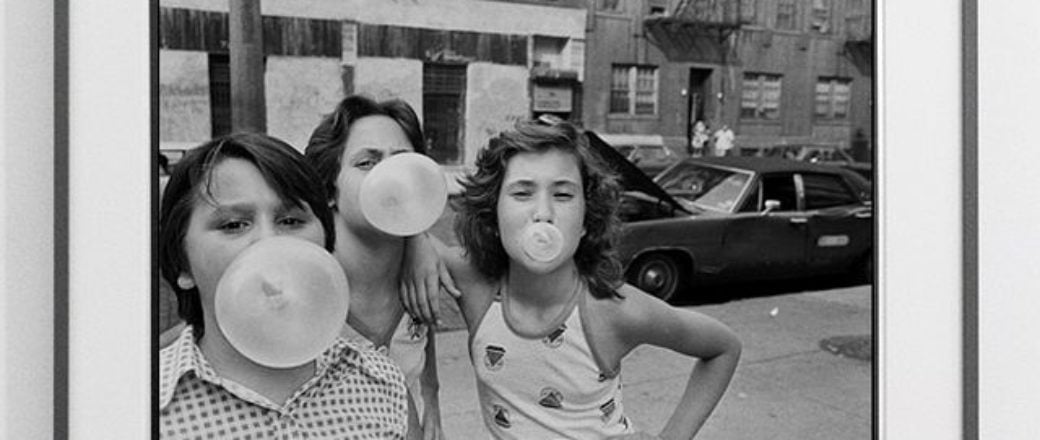
    American documentary photographer Susan Meiselas won the prestigious 2019 Deutsche Börse Photography Foundation Prize. The Baltimore native took the prize home at a ceremony in London on May 19. Awarding Meiselas the prize for her retrospective show “Mediations” at the Jeu de Paume gallery in Paris last year.

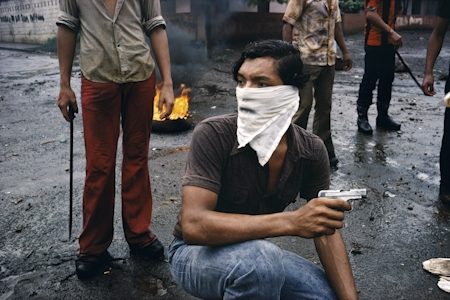
    Susan Meiselas - A man in a bandana holds a pistol while other armed men are behind him. There is a tire on fire in the background.
    NICARAGUA. Managua. 1979. Street fighter.

    Meiselas’ career began early on. Her first major photographic essay focused on the lives of women doing striptease at New England country fairs. There she photographed during three consecutive summers while teaching photography in New York public schools. Carnival Strippers was originally published in 1976. A selection of her photographs was installed at the Whitney Museum of Art in June 2000. More recently her work focuses on the conflict zones of Central America between 1978 and 1983. In particular her coverage of the Nicaraguan Revolution. Meiselas continues to make outstanding contributions to her art.

    “Susan’s consistent approach to the medium and her personal investment in the stories, histories, and communities she documents. She has carved out a new and important form of socially engaged photography,” said Brett Rogers, director of the Photographers’ Gallery in London.

    Deutsche Börse Photography Prize

    “The camera is an excuse to be someplace you don’t otherwise belong. It gives me both a point of connection and a point of separation.” Susan Meiselas

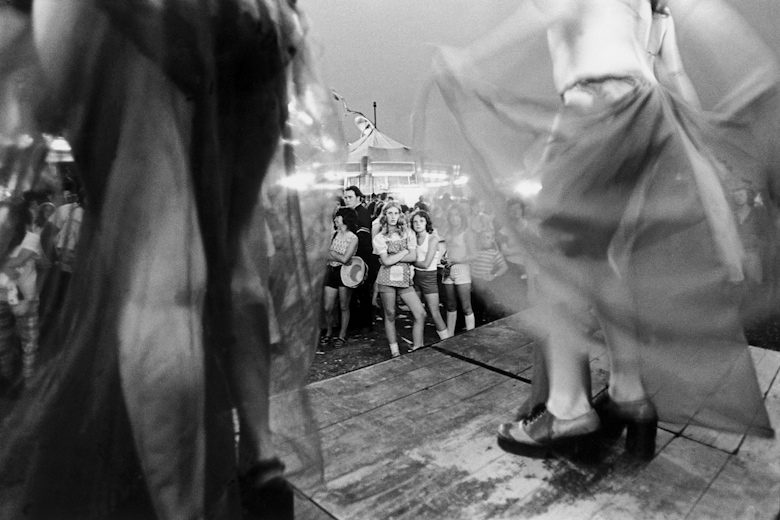
    Dancers on the stage while onlookers from the audience watch their skirts twirl.
    USA. Woodstock, Vermont. 1973. ©Susan Meiselas/Magnum Photos

    Announcing the winner of the prestigious award for European photography at an event at the Photographers’ Gallery. Where an exhibition featuring work by shortlisted artists has been on display since March 8. Meiselas chose to show her long-term project “Kurdistan/aka Kurdistan,” which focuses on the Kurdish diaspora, at the gallery.

    The award includes a prize of £30,000 ($38,600) in prize money. Photographers Laia Abril, Arwed Messmer, and Mark Ruwedel were also on the shortlist for projected winners. On June 14, the exhibition will move to the Deutsche Börse headquarters in Frankfurt, Germany. Where it will be on display until August 23.


  • Facebook V. #WeTheNipple

    Facebook V. #WeTheNipple

    Facebook Censorship

    Art censorship is nothing new to Facebook. However, a group of activists, the NCAC announced recently that Facebook will reevaluate its approach to artistic nudity. After months of protest, the site will sit and meet with the activist group. Together, they will go over the flaws in its nudity policy. Posing the question, will the nipple be freed, finally?

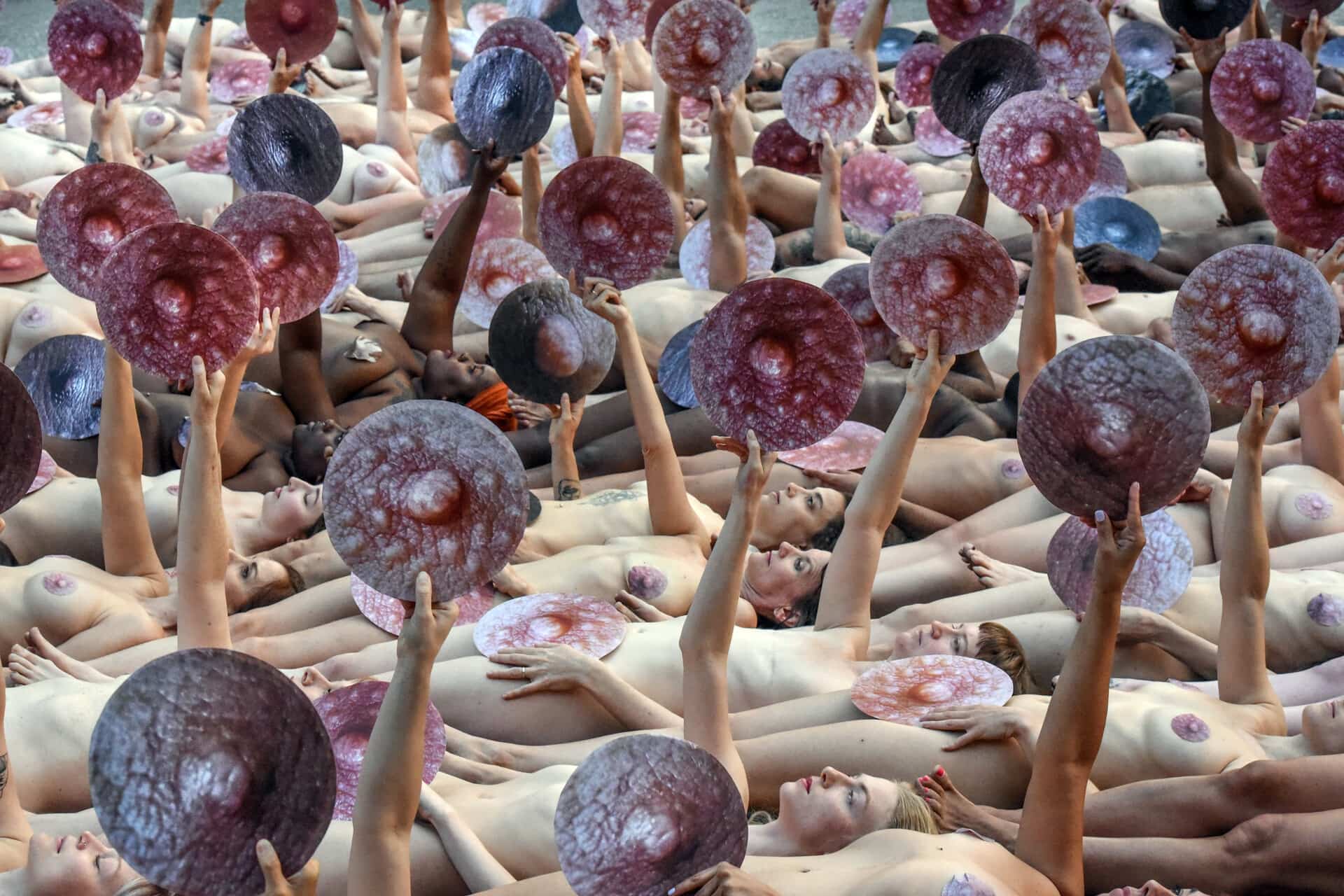
    This weeks protest took place at Facebooks headquarters in New York City. The National Coalition Against Censorship (NCAC), co-organized the event with photographer Spencer Tunick. Facebook will organize a “group of stakeholders including artists, art educators, museum curators, activists, as well as Facebook employees”. Collectively they will “discuss the issue of nude photographic art and the harm done to artists, provide insights into the challenges Facebook has faced in developing its nudity policies, and explore ideas for a path forward.”

    Members of women’s rights group Grab Them By The Ballot also took part in the demonstration. Explaining in a statement they will continue the task of “challenging the censorship of artistic female nudity by Facebook and Instagram’s ‘community standards.’”

    People pose nude holding cut outs of nipples during a photo shoot by artist Spencer Tunick on June 2, 2019 in New York
    NEW YORK, NY – JUNE 02: (This image contains partial nudity) (Photo by Stephanie Keith/Getty Images)

    Setting no official date the groups aim for talks this summer and will work directly with Facebook. Attempting to reassess the companies stance on the freedom of expression in the form of female nudity. Specifically the nipple – for which our male counterparts is not an issue.

    “We’re looking forward to working with Facebook and we’re heartened by their quick response to our campaign,”. Says a spokesperson for the group. Continuing; “We hope that by bringing stakeholders in the arts to the table with Facebook’s policy team and tech experts we’ll be able to work together to ensure that artists’ needs are valued in the decision-making process.”

    Free the Nipple

    Facebook recent attempts to update its policy toward nudity did not go unnoticed. The new policy, released last spring, allowed for paintings and sculptures that depict nude figures. In accordance with Facebook’s terms, women’s nipples are not allowed to be displayed. Unless in very specific contexts, such as photographs of breastfeeding, or to depict the aftermath of mastectomy surgery. However, these heavy restrictions still apply to fine-art photographs that contain nudity. However, men, have no such rules applied to their bodies.

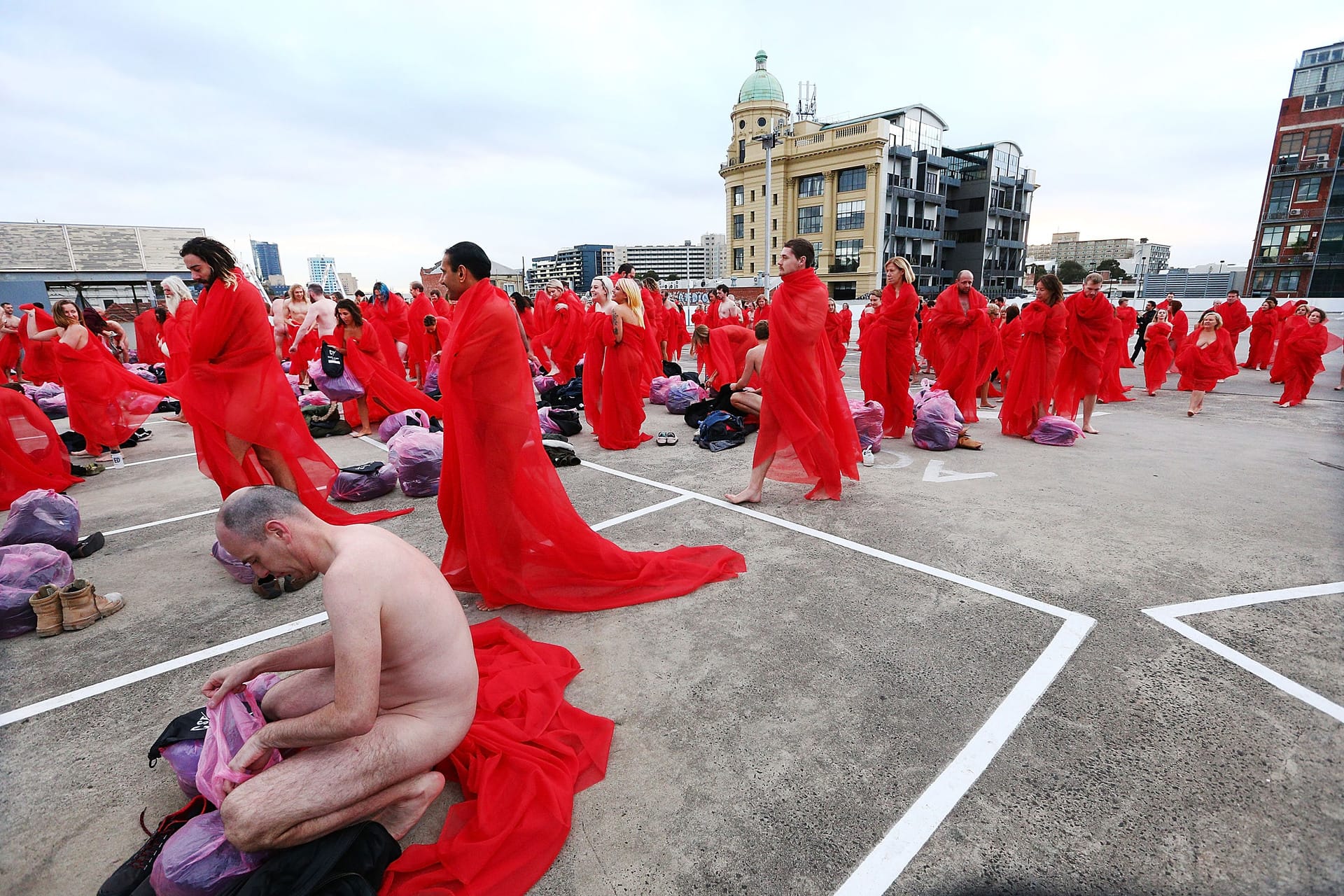
    Participants finish posing as part of Spencer Tunick's nude art installation Return of the Nude on July 9, 2018 in Melbourne, Australia.
    MELBOURNE, AUSTRALIA – JULY 09: ( Image contains nudity.) (Photo by Michael Dodge/Getty Images)

    To protest this policy, NCAC launched the #WeTheNipple campaign in April. Culminating their protest with a performance art installation and photoshoot, 125 volunteers took to the streets baring their complaints at the doorstep of the companies offices. The peaceful protest was photographed by Spencer Tunick who was inspired by the work of artist Micol Hebron. Issuing a letter to Monika Bickert, Facebook’s Head of Global Policy Management; the NCAC asked the company to commit to artists rather than censoring their expression.

    “We acknowledge that moderating content for billions of users with diverse values presents unprecedented challenges and that drawing the line between art and images that are not art is notoriously hard,”. “But this challenge does not justify banning all photographic images of the nude body, a ban that imposes the beliefs of some Facebook users on the entire world, stifles artistic expression, and enforces gender discrimination by permitting images of male nipples while prohibiting female nipples.”

    While Facebook is not the first suppressor of nudity in the female form – the conglomerate is constantly under scrutiny for its strict policies. Hopefully as the bridge of inquality between female and male nudity is shortened the company will also listen to protestors and #FreetheNipple for all.

  • Workers Strike at the Louvre

    Workers Strike at the Louvre

    Workers Strike at the Louvre

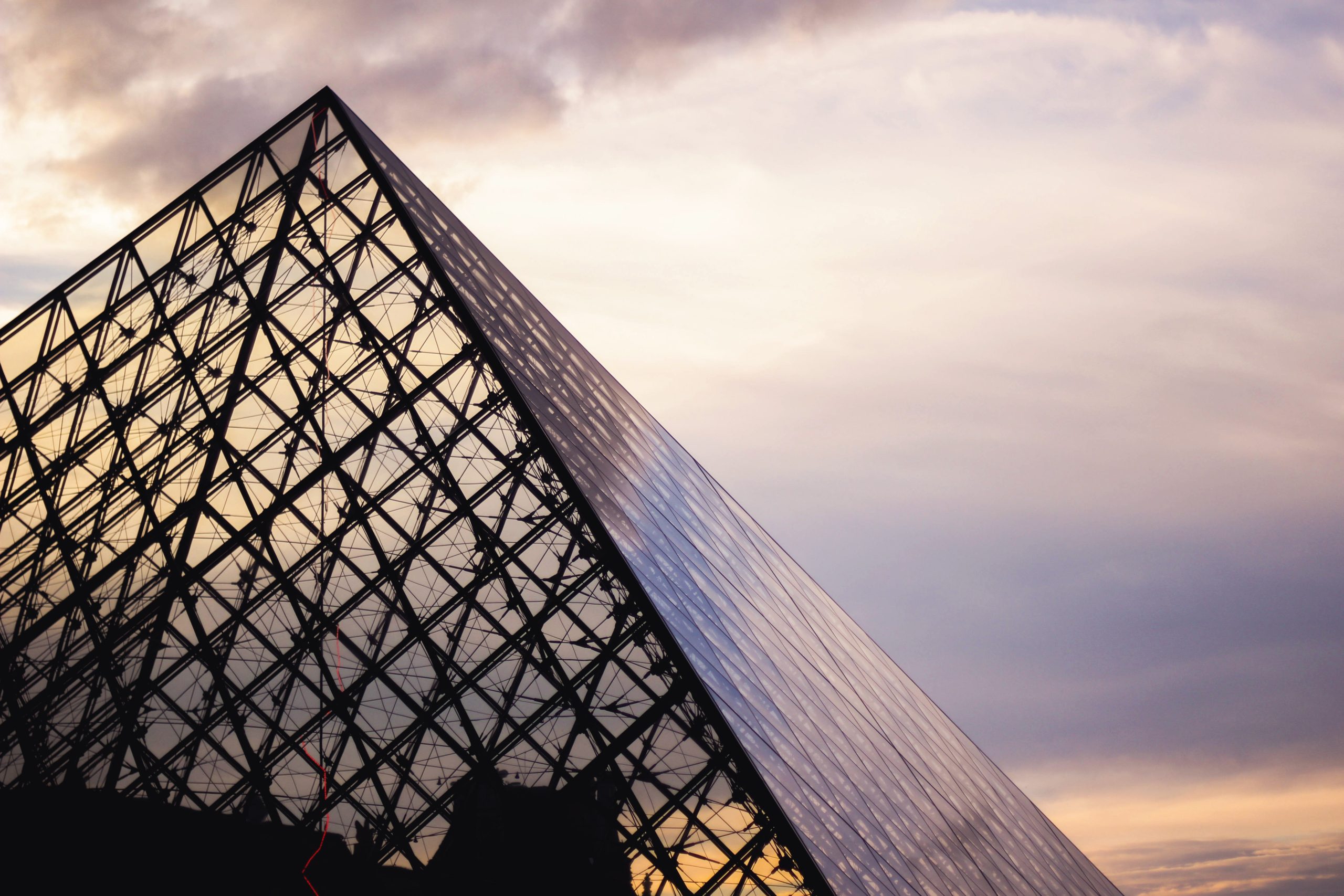
    Closing its famous doors and consequently leaving a mass of tourists outside amid its famous glass pyramids. The Louvre shut down due to workers strike. The Paris museum’s security and reception, protesting “unprecedented deterioration of conditions” amid record crowds.

    The museum, attracted a record 10.2 million visitors last year, a figure that is on the steady incline. An increase of over 20% from the year before. “No other museum in the world has ever equaled this figure,” the museum trumpeted in January.

    Unfortunately, the strain of the museums fame is not unique to staff members. Workers say both visitors and staff are suffering from such massive popularity.

    According to the Sud Culture Solidaires Union “The Louvre is suffocating,”. “While the public has increased by more than 20% since 2009, the palace has not grown. … Today the situation is untenable.”

    According to the union, staff members at the Louvre declined from 2,161, to 2,005 in a 9 year span.

    Shocked and disappointed American visitors tweeted their experiences to the museums unusual closing. “Well this is great,” tweeted one Californian. “Glad I got to the Louvre early.”

    In an attempt to mollify the public the museum is offering refunds for tickets purchased for the day.

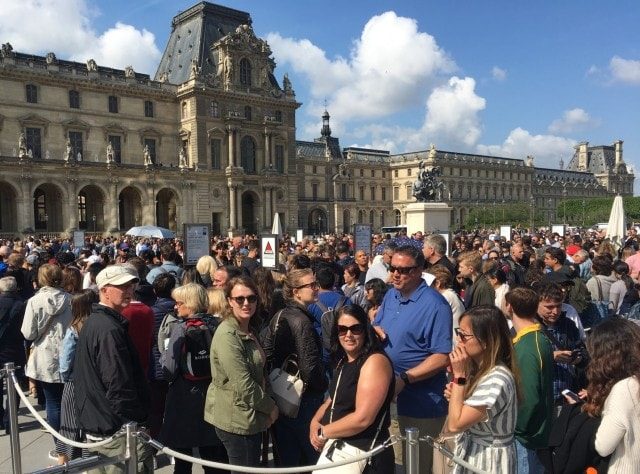
    Lone lines around the Louvre May 2019 during workers strike
    Long Lines at the Musee de Louvre May 2019

    Overcrowding and Online Sales

    Citing several problems, the Sud Culture Solidaires Union, states the bulk of the problem is due to the overcrowding conditions. Amplified by an aggressive and impatient public, jostling crowds and inadequate emergency evacuation measures.

    “What to say about visiting conditions when people are confronted with noise, trampling, crowds, extreme fatigue and the total inadequacy of museum facilities at such a high volume of visitors?” the union said in the statement. “The Louvre does not have the means of its ambitions.”

    Long lines form outside the Louvre as it remains closed due to workers strike.
    Patiently waiting entry to Musee de Louvre May 2019, amid the workers strike

    Closing its doors as is customary on Tuesday the museum saw the opportunity to forewarn the public. Following the workers strike, the museum website issued a notice stating the Louvre would open again late on Wednesday; after “a general meeting attended by members of the Musée du Louvre’s Reception and Security staff.” Warning that a large number of visitors were expected in the coming days recommending they buy tickets online.

    A Louvre employee and union representative, Pierre Zinenberg, told the Associated Press that the outcome of Wednesday’s meeting would determine whether the museum would re-open that day, or whether the strike would continue.

  • For the Love of Art: The Whitney Biennial

    For the Love of Art: The Whitney Biennial

    The Whitney Biennial

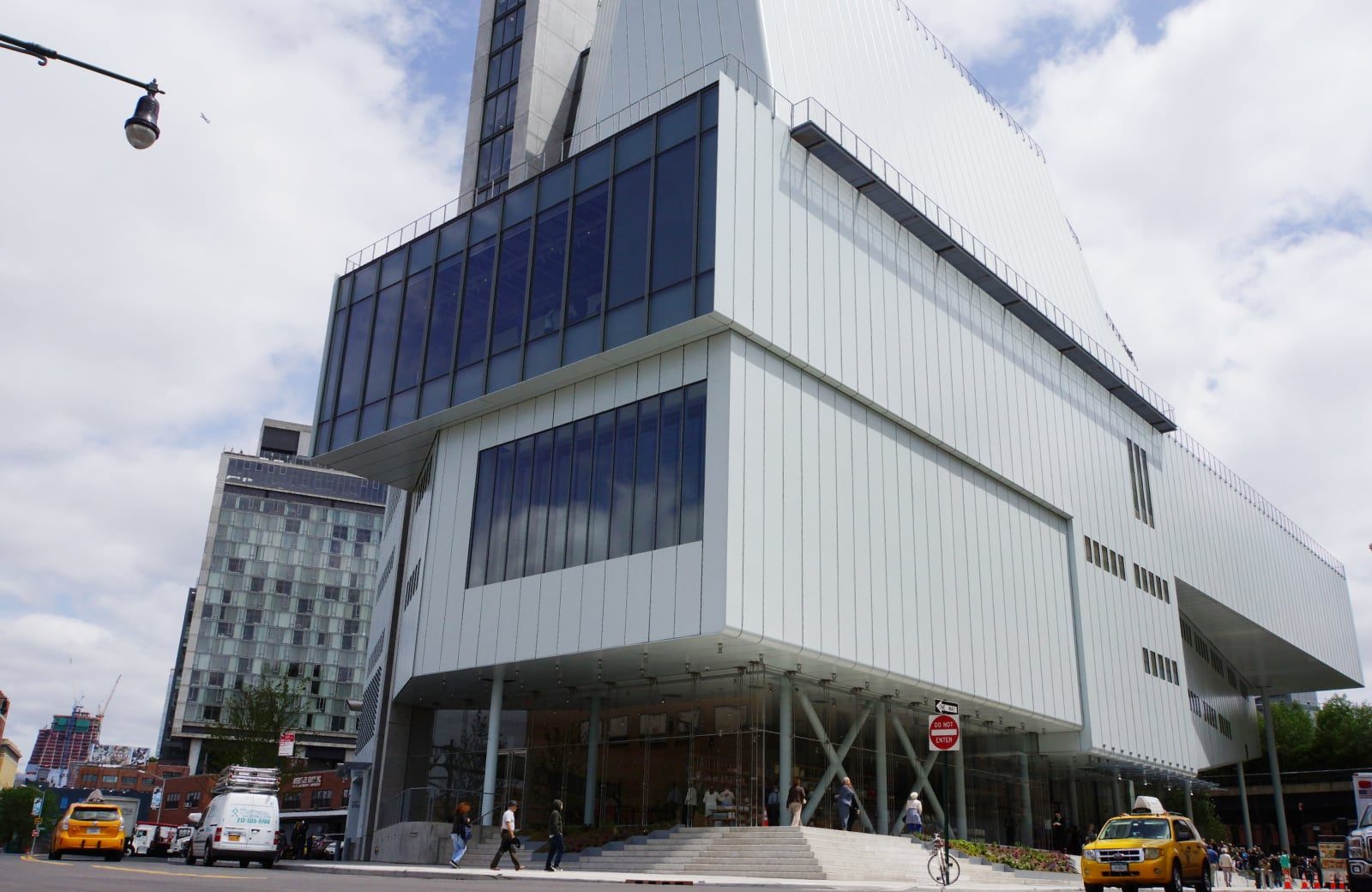
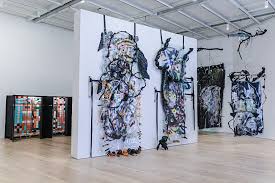
    The Whitney Biennial in New York often proves a reflection point for US social politics. Since the curator, Elizabeth Sussman’s landmark 1993 edition. She directly took on the Reagan-era Culture Wars using provocative works by women and LGBTQ artists. No stranger to controversy this year’s edition curators Jane Panetta and Rujeko Hockley, face protest by the group – Decolonize This Place; DTP.

    Jane Panetta and Rujeko Hockley, the curators behind the 2019 edition, are posed to navigate these political waters. This year’s organizers are on staff and know first-hand the controversies that the biennial can inspire.

    “We’ve tried to use the challenges and conversations that came out of the last [edition] as a productive lens for our work,” Panetta says. There is a great deal of work in the show that comes to terms with socio-political concerns. Not excluding challenging race and gender, financial inequality, gentrification and the vulnerability of the body.

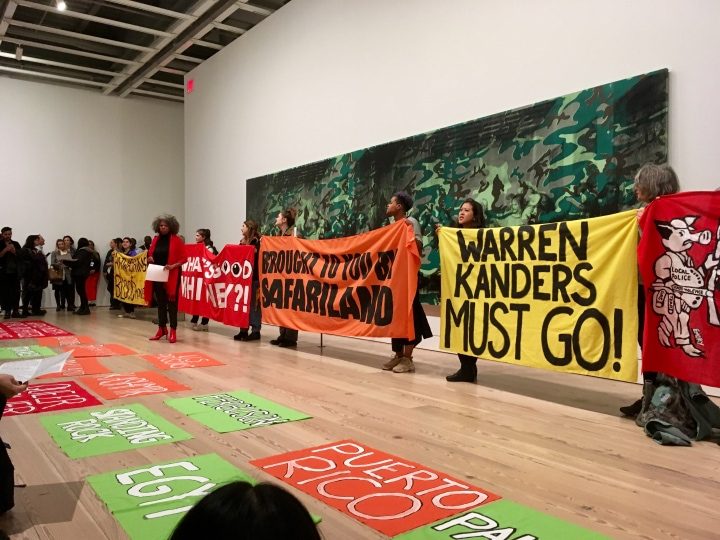
    The activist group Decolonize This Place (DTP) held weekly protests against Warren B. Kanders, the owner of a company, Safariland, that produces military supplies. A letter recently published calls for his removal by Verso press. The letter includes around 200 signatures from artists, curators, critics the letter includes signatures of more than half of the artists in the exhibition. Among these are Colectivo los Ingrávidos, Fernandes and Nicole Eisenman.

    The Whitney Biennial 2017
    The Whitney Biennial 2017

    Drama at the Whitney

    Considering the stress on inclusion and diversity, the 2019 biennial is in political hot water. Artist Michael Rakowitz refused to participate in the show. This act of protest against the Whitney Museum is due to their financial ties to Safariland. A company owned by the museum’s vice-chairman Warren Kanders. Safariland manufactures tear gas canisters that have been used against asylum seekers along the US-Mexico border.

    It is not surprising considering the current political climate that passionate artist take issue with board members at the Whitney Museum. We are in a crisis, the environment, the poor, the truth are all in the crosshairs of the political machine. However, it is the art museum, to take a stand, and take place on the grandstand of the political play.

    The mounting pressure has yet to yield any action on the Whitney’s part. However, it has prompted concern that these actions place undue duress on artists. For whom being included in the exhibition is a huge boon to their career.

    Marz Saffore is one of the core members of DTP. She is helping the protest taking place. She states that the issues are collective. “As a queer black woman who is also an artist, there is no separation between politics and livelihood,” she says. Although she notes that there was never any call by DTP for this year’s artists to withdraw.

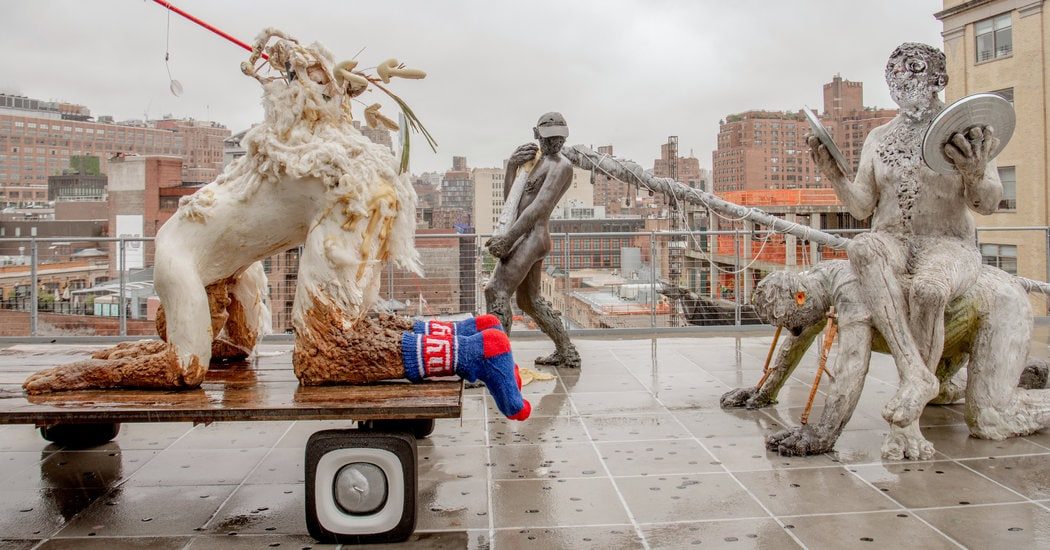
    A rare spectacle in the Whitney Museum’s Biennial. Installed on the sixth-floor terrace, its lurching figures
    Nicole Eisenman’s “Procession” (2019)

    This Years Artist

    After visiting over 300 studios, Panetta and Hockley assembled one of the Whitney Biennial’s most diverse rosters of emerging and mid-career American artists. The majority of artists this year are of color. There is also an even divide between male and female participants. “We wanted our biennial to feel [as though it was] of this historical moment and to be reflective of the world we actually live in,” Hockley says, adding that it was “critically important” to present a multiplicity of voices in a wide range of mediums.

    The 2019 biennial boasts a larger range of new media and performance works than in previous years. Including significant video components in the galleries and in a standalone program in the museum’s theatre. The galleries feature work by Korakrit Arunanondchai, Garrett Bradley, Colectivo Los Ingrávidos, Thirza Cuthand, Forensic Architecture, Ellie Ga and Ilana Harris-Babou. Consequently, this years group of artists is also younger than in previous years. Three-quarters of the artists are under 40, and 20 of them under 33.

    Arts And Politics

    Protest at the Whitney Museum of American Art -March 2019

    Protest at the Whitney Museum of American Art – 2019

    All museums have ethical practice guidelines in place. Unfortunately, these don’t always cover the full range of potential objections to trustee appointments. At present these issues include involving arms manufacture, corporate drug production, and climate change. These issues are global issues. As Marz Saffore states, these are issues that affect the collective community. The judging panel is charged with reviewing these circumstances case by case. Tasking them with the hard goal of finding a balance between idealism and funding.

    Consequently, the question of Mr. Kanders’s staying or going doesn’t outweigh the discussion and protest his presence has raised. Hopefully, leading to further discussions about institutional ethics, and politics in our art.

  • Vincent Van Gogh Restored

    Vincent Van Gogh Restored

    Vincent Van Gogh Paintings

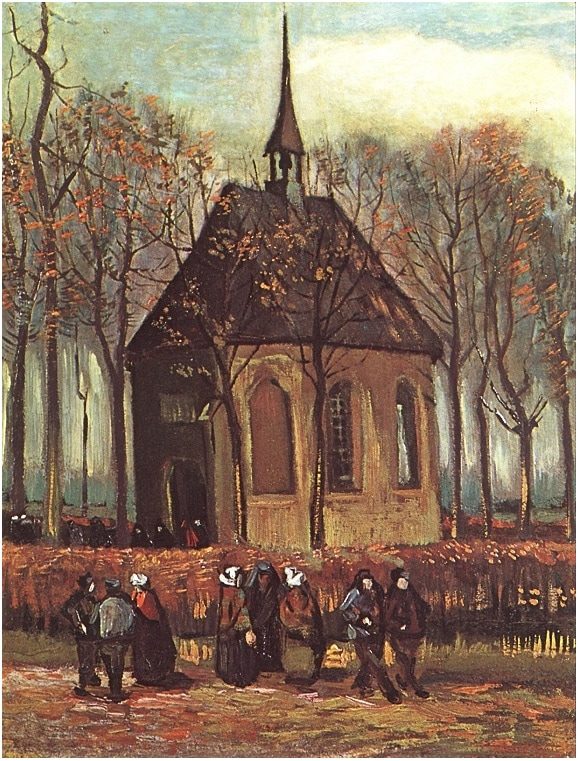
    Two classic Vincent Van Gogh paintings are back on public display after seventeen years. Stealing the painting in 2002, the thieves used a ladder to enter the Van Gogh Museum in Amsterdam. The Dutch master’s pieces, “View of the Sea at Scheveningen” and “Congregation Leaving the Reformed Church in Nuenen,” are currently back on display at the museum. Placing these Vincent Van Gogh paintings back in their rightful homes.

    Authorities were led to the paintings after a 14-year search and investigation into a group linked to the Italian mafia. Museum staff spent two years examining the damage to the paintings and restoring them. Hanging them up recently in the museum galleries. “We are delighted to be able to put these significant works in our collection. Back on display in the museum, where they belong,” museum director Axel Ruger said in a statement. “The conservators have done a brilliant job and the paintings will now go back on permanent display in their full glory, for everyone to see.”

    Congregation Leaving the Reformed Church in Nuenen - Van Gogh 1884
    Congregation Leaving the Reformed Church in Nuenen – Van Gogh -1884

    Both paintings required conservation treatment

    Undergoing conservation treatment the paintings, which date from the 1880s, restorators assessed their damages before they returned to public display. During its time away from the museum, “View of the Sea at Scheveningen,” one of Van Gogh’s earliest works in oil paint, sustained some harm. According to the museum, the significance of this painting is two-fold, as it is one of two seascapes by Van Gogh in the Netherlands. Unfortunately, during the theft, a piece of paint was missing from the bottom left-hand corner. However, museum conservators using a 3D-printed mold replicating the original brushstrokes were able to restore the painting.

    During the conservation treatment process, they found the remains of a signature “Vincent.” However, the museum believes that Van Gogh himself did not write it. Fortunately, “Congregation Leaving the Reformed Church in Nuenen,” sustained hardly any damage, the museum said. The painting depicts the church in Nuenen, a city in the Netherlands, where Van Gogh’s father was the minister.

    View of the Sea at Scheveningen - Van Gogh 1882
    View of the Sea at Scheveningen – Van Gogh 1882

    The museum found that both paintings were covered with a varnish. The varnish was not present before and subsequently yellowed over time. Conservators were able to remove the layers of varnish and retouch the paintings. Consequently, in the process of removing varnish from “Congregation Leaving the Reformed Church in Nuenen,” they discovered Van Gogh likely applied himself. Clues pointing to the protein-based and marks the first time confirmed their suspicions. Noting that this particular varnish being used painter’s early work. The museum has also selected new frames for both paintings. The thieves removing the previous ones. This is not the first happy ending in recent Dutch history – hopefully, this pattern of restoring paintings to their rightful owners will continue.


    .

  • The Rise of Street Art

    The Rise of Street Art

    The Rise of Street Art

    The rise of street art began during the 1970s. Street art as a creative practice stems from the prevalent graffiti community. Graffiti artist grace the streets around the globe, sometimes without permission, in forms of posters, stencil art, and social commentary. This tradition dating back to the early 16th century when anonymous satirical poems were attached to the base of the talking statues of Rome. This form of expression was an outlet for unwarranted social and political opinions.

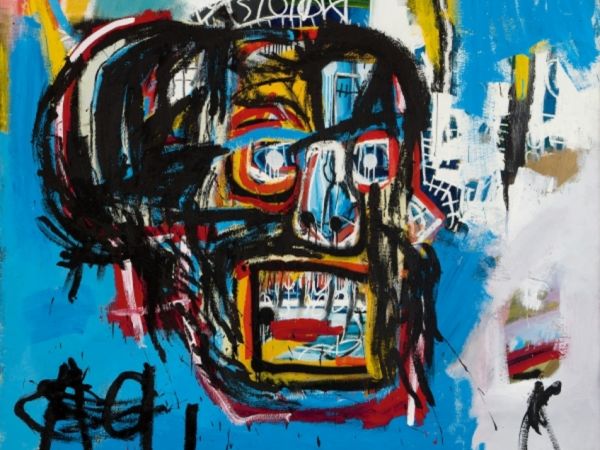
    Crowning him as one of the forefathers of the modern Urban Art movement Jean- Michel Basquiat said: “Fire will attract more attention than any other cry for help,”. Attaching Basquiat’s claim in the context of Street Art, there is no better canvas to start a blaze than the walls and passageways. Where the attention of the general public serves as a guarantee for the artists’ message.

    Jean-Michel Basquiat (American, 1960–1988). Untitled, 1982
    Jean-Michel Basquiat (American, 1960–1988). Untitled, 1982

    In Early Modern Rome, artists were faced with losing a hand or worse. However, street artists’ today face punishments of differing degrees. Often times falling into the grey area between artistic expression and vandalism. This is subsequently illustrated by the arrest of the street artist Zevs in Hong Kong in 2009. He painted a “liquidated” Chanel logo on the wall of the Giorgio Armani flagship store. Reflecting the war of brands, this creative act was ultimately deemed unwelcome.

    Urban Art

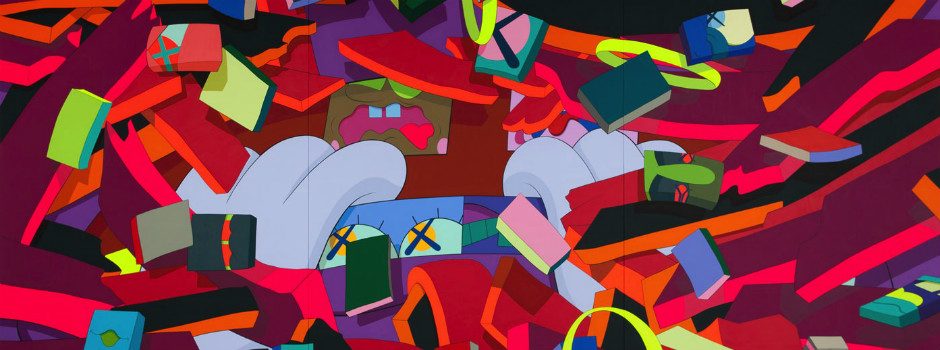
    Nevertheless, Street Art has become an accepted artistic genre. The increasing embrace by the general public as well as institutions is evident around the world. Some cities including Boston and New York and Paris now have general spaces for street artist to display their works. Some of the great names in contemporary art, such as Kaws, Keith Haring, and Banksy, trace their career roots back to their creative output on the streets. Their works are in major museum collections around the globe. by seasoned and new collectors alike.

    Artists have freed art from the bounds of gallery and museums walls and subsequently transformed the public’s understanding of where and how to view art. Making it accessible to everyone.

    Street Art Effect

    Nunca – Untitled
    Nunca – Untitled

    Francisco Rodrigues da Silva, also known as Nunca, is an artist who uses urban space as his canvas. A native of Sau Paulo, Nunca explores the past and present Brazilian culture. He incorporates indigenous figures in his multi-colored compositions while confronting them with the modern landscape. In 2008, Nunca and five other internationally acclaimed artists known for their street art practice were commissioned to adorn the river facade of Tate Modern in London. This was the first major public museum display of street art in London.

    The exhibition highlighted an important aspect of “Street Art” as a dated terminology. These artists are widely known as “street artists”. However, they continue to work in the traditions of artists before them. Creating works on paper, canvases, and sculptures, and are not limited to murals and text-based graffiti.

    Banksy Dreams Cancelled.
    Banksy – Dreams Cancelled

    Street art is integrating into people’s everyday lives. However, it also manifests in forms that are seen in our experiences with common objects. Materials collected from the streets, such as scraps of cardboard, plastic, spray cans, and broken glass, renews the viewing public’s attention. Focusing on things that are easily dismissed in the comings and goings of hectic urban life. The resulting artworks act as message a reflection of our society and are the jumping off point that further blurs the boundary between art and life.


  • New York Auction Season

    New York Auction Season

    New York Auction Season

    The New York auction season got its start in high fashion at Rockefeller Center headquarters. The evening sales of Impressionist and Modern art rounded out the auction at $399 million. Selling a staggering 86% percent of what was on offer. New auction records were set for works by Balthus and Pierre Bonnard.

    Setting the tone for the evening was the sale of several trophy works from the collection of the late publishing magnate S.I. Newhouse. His estate accounting for $100.1 million; more than a fourth of the sale total. Opening of the room to bidding, it was announced that new third-party guarantees were in place for three Newhouse lots. These lots included a still life by Paul Cézanne and a Vincent van Gogh landscape, the eventual two top sellers of the evening.

    A number of Christie’s specialists from Asia were notably active throughout the evening. Bidding for clients via the phone bank. This feverish bidding started with the top lot, won by Rebecca Wei, president of Christie’s Asia, for a phone client. The work, an immaculate still life by Cézanne, Bouilloire et fruits (1888–90), estimated in the region of $40 million.

    Bouilloire et fruits - Paul Cézanne. A selection of fruits sit besides a water pitcher on top of a white table cloth.
    Paul Cézanne ( Bouilloire et fruits)

    Once part of a notorious 1978 robbery from collector Michael Bakwin in the Berkshires in Massachusetts. The Cézanne was recovered in 1999. Consequently, in that same year, S.I. Newhouse bought it for $29.5 million at Sotheby’s London.

    Rising Stars

    The Newhouse consignment brought many well-known paintings to the auction, including the van Gogh landscape, Arbres Dans le Jardin de l’asile, painted in Saint Rémy in 1889. The painting originally estimated at $25 million. Opening bidding at $17 million the work was sought after by five phone bidders. The final hammer came down at $33 million. Including the buyer’s premium, the final price set at $40 million.

    Auctioneer Adrian Meyer opened the bidding at $30 million. Drawing roughly half a dozen bids from various Christie’s specialists. Finally hammering down to Wei’s client at $52 million. Perhaps a sign of her buyer’s determination to win the prized painting, Wei’s first bid came after the price rose to $48 million. Including the buyer’s premium, the final price was $59.3 million.

    It was another skyrocketing lot, however, the bidding contest shorter than some of the treasured paintings. Opening bidding at around $22 million. Betting correctly that the hot streak for works by Amedeo Modigliani would continue. Carrying a third-party guarantee with a rare limestone sculpture, Tête (circa 1911–12), priced at $30 million to $40 million. Bidding eventually rose to $30 million. Finally hammering down to a client bidding over the telephone.

    Record. Set. Sold.

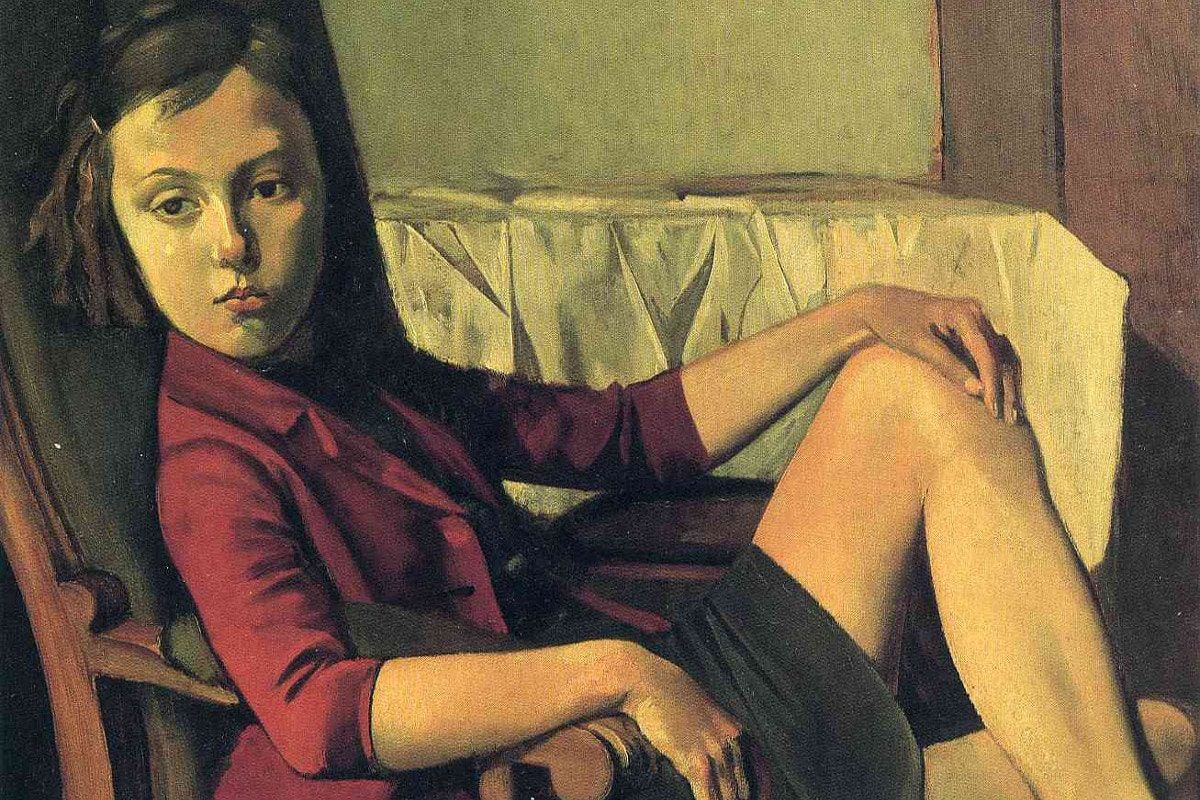
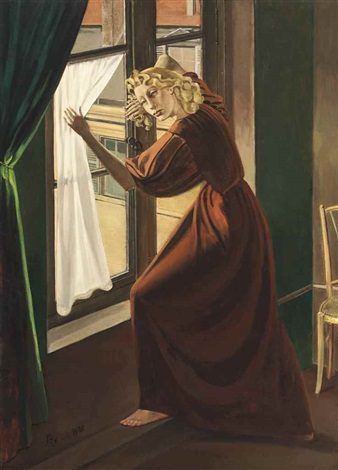
    A new auction record was set for Balthus’s work with his painting, Thérèse sur une banquette (1939). Previously gracing the cover of the Metropolitan Museum of Art’s major retrospective catalog. The painting sold for $19 million, compared with expectations of $12 million to $18 million. The price was more than double the previous New York auction season record for a work by the artist. Originally set at Christie’s New York in November 2015 with the $9.9 million sale of Lady Abdy (1935).

    Lady Abdy - Balthus 1935. Lady Abdy dressed in a red gown looks longingly out of her window.
    Lady Abdy – Balthus (1935)

    Also soliciting high demand, and resulting in a new auction record, was Pierre Bonnard’s La Terrasse ou Une terrasse à Grasse (1912). The artwork is a premier piece from the Drue Heinz collection. Bidding opened at $3.8 million against expectations of $5 million to $8 million. Finally coming down to a two-way bidding battle via Christie’s specialists. The final price rose to $16 million. Leagues above the previous record for a work by Bonnard.

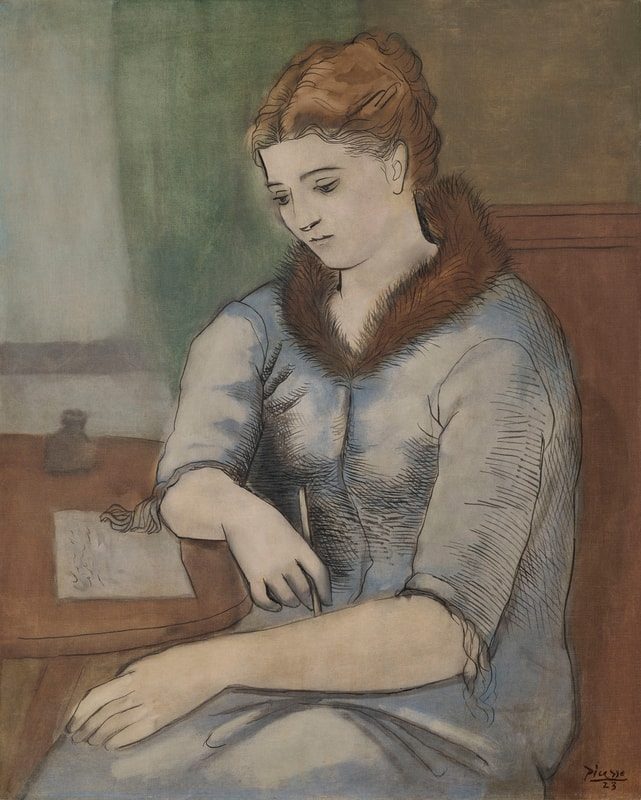
    While placing it oddly as the final lot of the sale, given its lofty $20 million to $30 million estimate—was Picasso’s portrait La Lettre (La Réponse) from 1923. Achieving the fourth-highest price of the sale, selling for $25.2 million prices including premium.

    La Lettre ( La Réponse) Picasso 1923

    Hailing from the collection of H.S.H. Princess “Titi” von Fürstenberg, which also included a Mark Rothko painting that fetched $5.4 million. An unusual inclusion for an Impressionist sale, but which performed well nonetheless considering expectations of $2 million to $3 million.

  • Artist We Love: Mikhail Turovsky

    Artist We Love: Mikhail Turovsky

    Artist We Love: Mikhail Turovsky

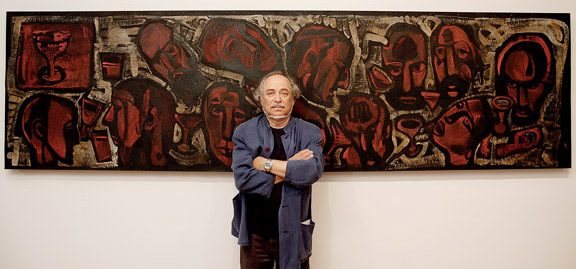
    Born in Kiev on May 8th, 1933, Mikhail Turovsky is an artist we love here at RDN Arts.
    His father, a soldier in the Soviet Army, passed away three months after the outbreak of World War II. Three days before the Nazis began their genocide, along with his mother and younger brother, he managed to flee from Kiev. He studied drawing and pictorial arts in the Kiev Art Institute from which he obtained his degree in 1960. He continued his studies in the Moscow Academy of Art.

    During his time at the academy the President, Vladimir Sirov, took note of him.
    Impressed by the artistic gifts of the young student, took him under his wing, ignoring official bywords, launching him on his professional career. It did not take long before Turovsky became a consummate master of the “academic style”, with paintings exalting official Soviet subjects. He joined the Artists’ Union, the most famous and select association of painters in the USSR.

    Seeking later in his career more creative freedoms Turovsky would move to New York – where he has lived since 1979.

    Artist We Love: The Peoples Painter

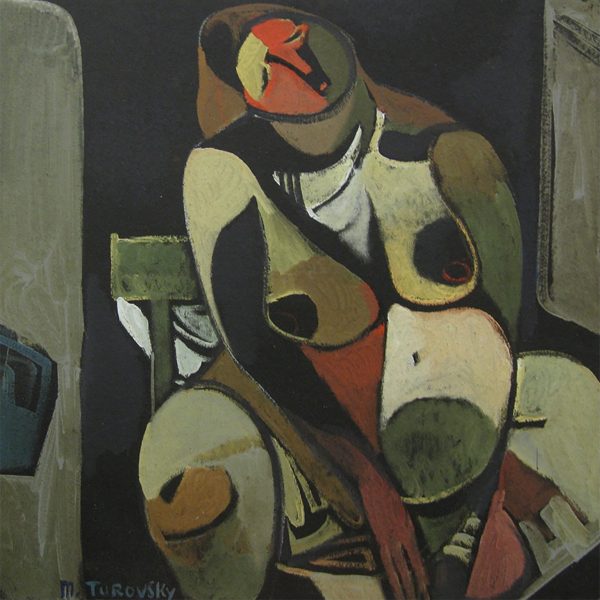
    Full of light and color; this painting is a stunning display of a body at rest. The magic lays within the colors and the forms the artist uses to present a woman at peace.
    Oil On Canvas Woman Seated in Figuabstract

    He became so famous that the Government of the Soviet Republic of Ukraine commissioned him to paint the official portrait of Leonid Brezhnev, Head of State of the USSR at the time. He exhibited in salons in Europe and South America. Nevertheless, he felt that Communism was fossilizing and restricting his freedom of expression. Turovsky enjoyed his privileged social position. However, not being able to paint the subjects that attracted him remained an issue.

    Unable to express himself freely, either as a man or as an artist. In Russia, one could only paint nudes that depicted athletes or ballerinas in a triumphant pose. He wanted his work to portray his own revelation. He set out on the path of protest In 1974, he came into open conflict with the Regime. Censoring his paintings due to their subversiveness. Finally, Turovsky came to the definitive decision that he could no longer live in a country that prevented him from reaching his artistic plenitude.

    Career

    Turovsky commenced a prolific creative career in 1957, participating in numerous exhibitions of Ukrainian art in Kiev, Moscow, as well as in many traveling exhibitions to Europe and Latin America. In 1962 he became a member of the Union of Artists of USSR.

    Forsaking his official career for the sake of creative freedom he and his family emigrated to the United States in 1979. The Turovsky family first settled in the Bronx where he continued his work. After that important move, his career developed rapidly. His international reputation grew as he exhibited in New York, Jerusalem, Paris, Brussels, Madrid, Venice, Arles.

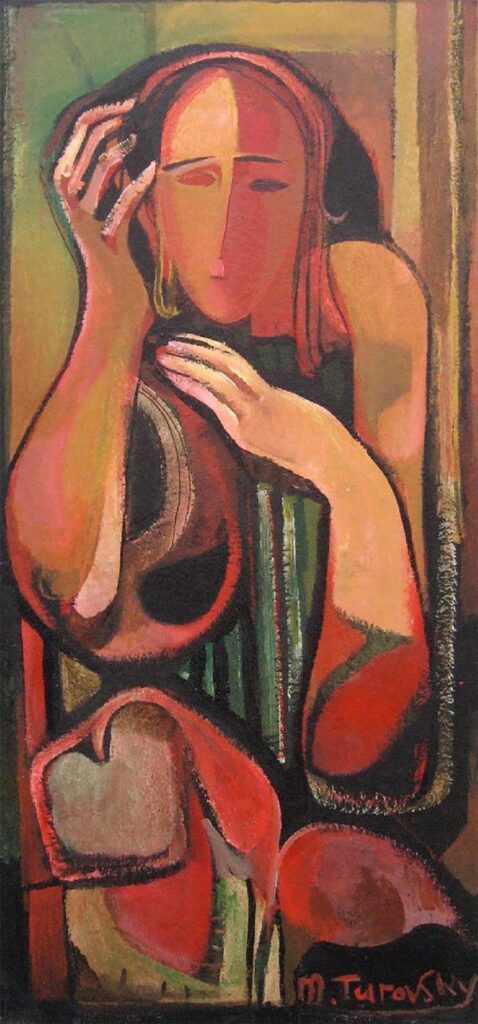
    Distancing himself from reality he distorts typical forms to create finally, a very breathtaking human figure. Red and green hues set the frame, adding richness and texture to the piece.
    Oil on Canvas Woman Leaning her Arm

    In the late 1980s, Turovsky began to address themes that always moved him: the female figure, motherhood, the eternal themes of art. Developing a style which the French art critics dubbed: figure abstraction. Figure abstraction is combining the elements of figurative and abstract art. His palette became brighter, more joyous and energetic. This was noticed by the French dealer Serge Lencner. Their collaboration led to a series of European exhibitions, and publications and interviews in television and radio.

    Artist We Love: Around The World

    Mikhail Turovsky’s work is represented in permanent collections of the National Art Museum of Ukraine in Kiev, the State Tretyakov Gallery in Moscow, the Yad Vashem Memorial Art Museum in Jerusalem, the Herbert Johnson Museum of Art at Cornell University in New York, and the Notre Dame University Art Museum in Indiana, as well as many public and private collections. Among his well-known works are the cycle Holocaust, The End of an Utopia‘, many nudes, landscapes and the series “Still Life”; illustrations to the works of Ivan Franko, Vasyl Stefanyk, Aleksandr Blok, Sholom-Aleichem, Lion Feuchtwanger, Johannes Becher, and many other writers.

    He discovered freedom in his move to New York. During the first years of his new life, he worked ceaselessly. His new subjects, formerly proscribed, led him to produce authentic masterpieces. New York, a crucible of creation and miscegenation, caused him to experience a magnificent rebirth, Dedicating many years to the Holocaust as the effects of the massacre have contributed to the memory of Humanity. His work on this subject ending up in museums. Turovsky’s work reflects the shock between the culture of the West and that of the Eastern Bloc. The artist, fascinated by the vitality of North American artists, their audacity and their creative spirit. These were years of change, a period of synthesis marked by the advent of color.

    Art We Love

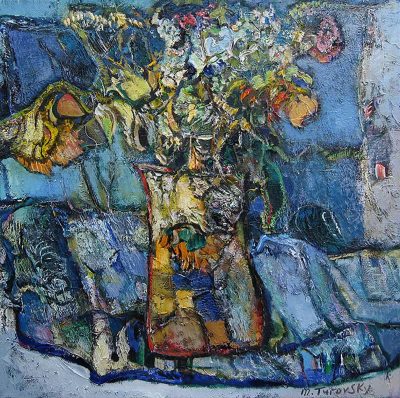
    Oil on Canvas Autumn Flowers

    Turovsky is an artist of great range and energy. He constantly experiments with diverse materials, is extremely prolific in his output. Turovsky is one of the great masters of our time in the field of painting. He continues to develop the figurative tradition enriched by the achievements of modernism. His paintings have been shown in various galleries in Europe and America. His works have been exhibited in galleries and public spaces of such cities as New York, Philadelphia, Paris, Geneva, Madrid, Bordeaux, Lyon, Lille, Brussels, and Venice during the 1999 Venice Bienniale. Turovsky adds richness to the canvas with his keen sense of imagination. Furthermore, he is an artist who is daring and creative. His unique incite continues to captivate the world over.

  • Venice Biennale Top Shows

    Venice Biennale Top Shows

    Venice Biennale Top Shows

    A record high 90 countries participated in what is considered the Olympics of the art world. They compete to win the coveted Golden Lion for the best national pavilion. Countries from around the world descend on the Italian city to show off the best art their country has to offer. However it’s impossible to see all 90, we’ve rounded up a few of the Venice Biennale tops shows. Here are a few of the national pavilions not to miss at the Venice Biennale.

    France

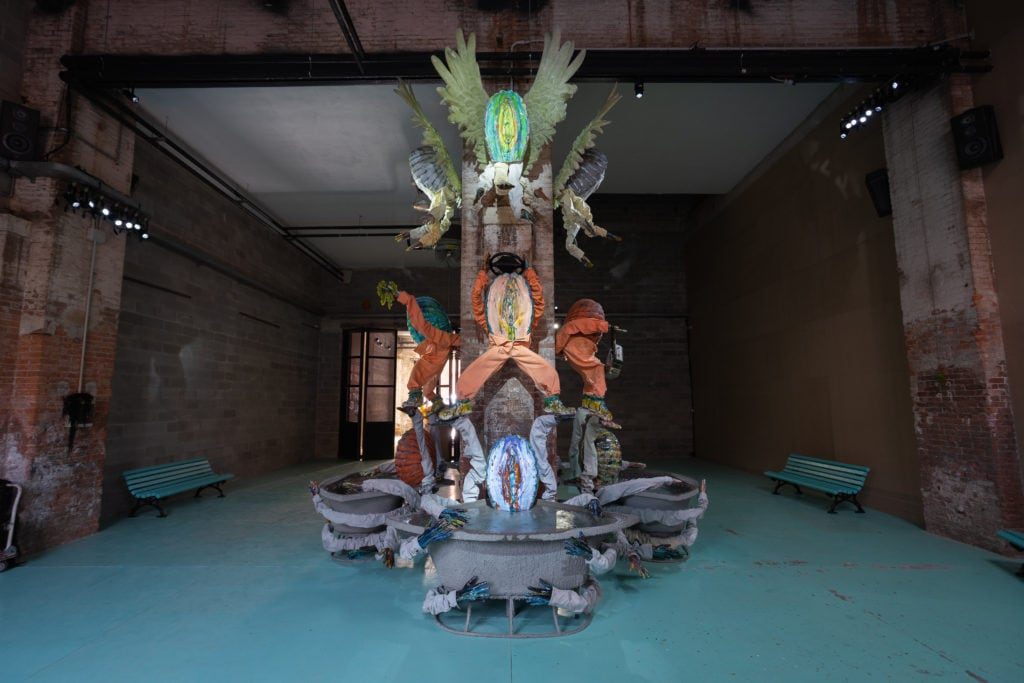
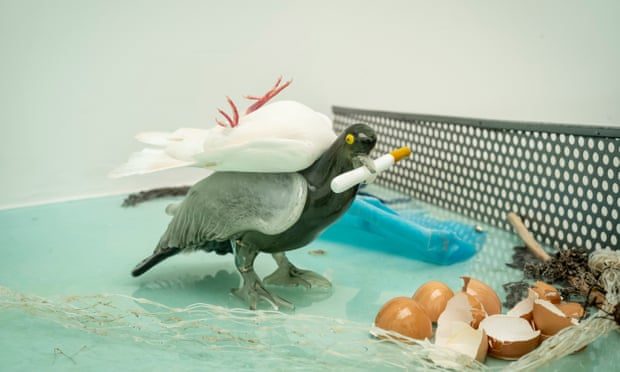
    Deep See Blue Surrounding You / Vois Ce Bleu Profond Te Fondre Artist: Laure Prouvost

    Curator: Martha Kirszenbaum

    Location: Giardini

    Laure Prouvost, “Deep See Blue Surrounding You / Vois Ce Bleu Profond Te Fondre,” French Pavilion at the 58th Venice Biennale, 2019. © Giacomo Cosua.

    Beneath her dreamlike creation of the French pavilion, Laure Prouvost is digging an illicit tunnel to the nearby British Pavilion. This Venice Benniale top show represents France but the artist feels a strong connection to England. She hasn’t asked permission to dig her tunnel. However, she’s done it anyway with hiding it. The action itself illuminates the transparent nationalist values in an international event like the Biennale. The hour-long lines for the main event of the pavilion is a direct correlation with its effect on the audience. Its characters flip between English and French, steering into nonsensical mistranslations. Consequently throwing into question some of the assumptions embedded within a language.

    Brazil

    SwinguerraArtists: Bárbara Wagner and Benjamin de Burca

    Curator: Gabriel Pérez-Barreiro

    Location: Giardini

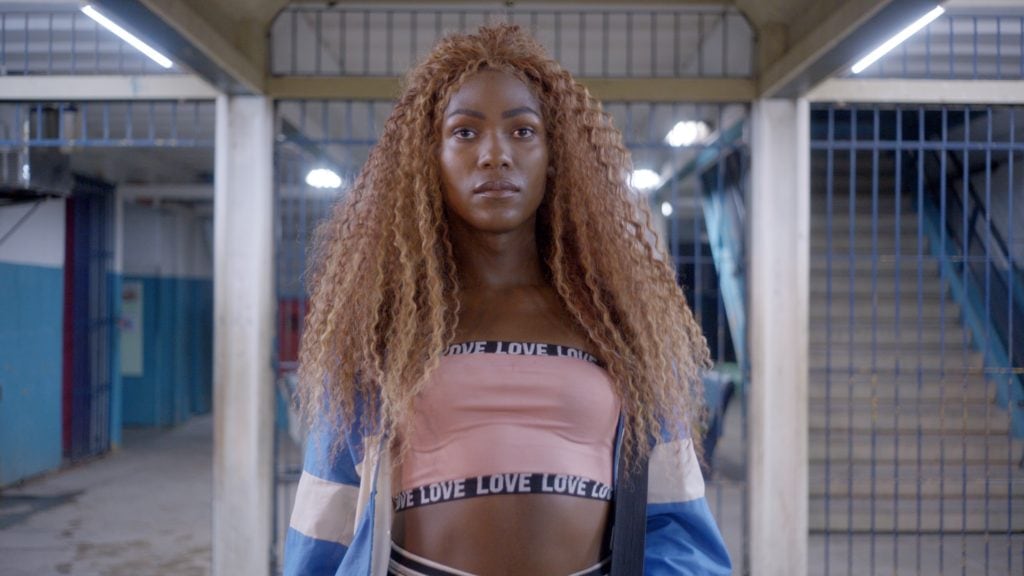
    Still from Swinguerra (2019) by Barbara Wagner and Benjamin de Burca at the Brazil Pavilion at the 2019 Venice Biennale.

    Artist duo Bárbara Wagner and Benjamin de Burca’s video installation transports the viewer into the world of swingueira. Swingueira is a style of dance popular on the outskirts of Recife. The artists capture the life of the dancers at work, their interactions with each other on the sidelines as they video each other with their cellphones. The video, made in close collaboration with the dancers captures a routine practice session. Captivating us in and out of their individual music video fantasies. However, it’s not all glitter and gyrations. The name of the project, Swinguerra, combines the style of dance and the Portuguese word for war. Referencing the fact that these dancers are also at the focus point of an offscreen sociopolitical debate in Brazil. Similarly to the countries politics, asking the question of whether their bodies have the right to exist.

    Lithuania

    Sun & Sea (Marina) Artists: Rugilė Barzdžiukaitė, Vaiva Grainytė, and Lina Lapelytė

    Curator: Lucia Pietroiusti

    Location: Marina Militare, Calle de la Celestia, Castello, 30122

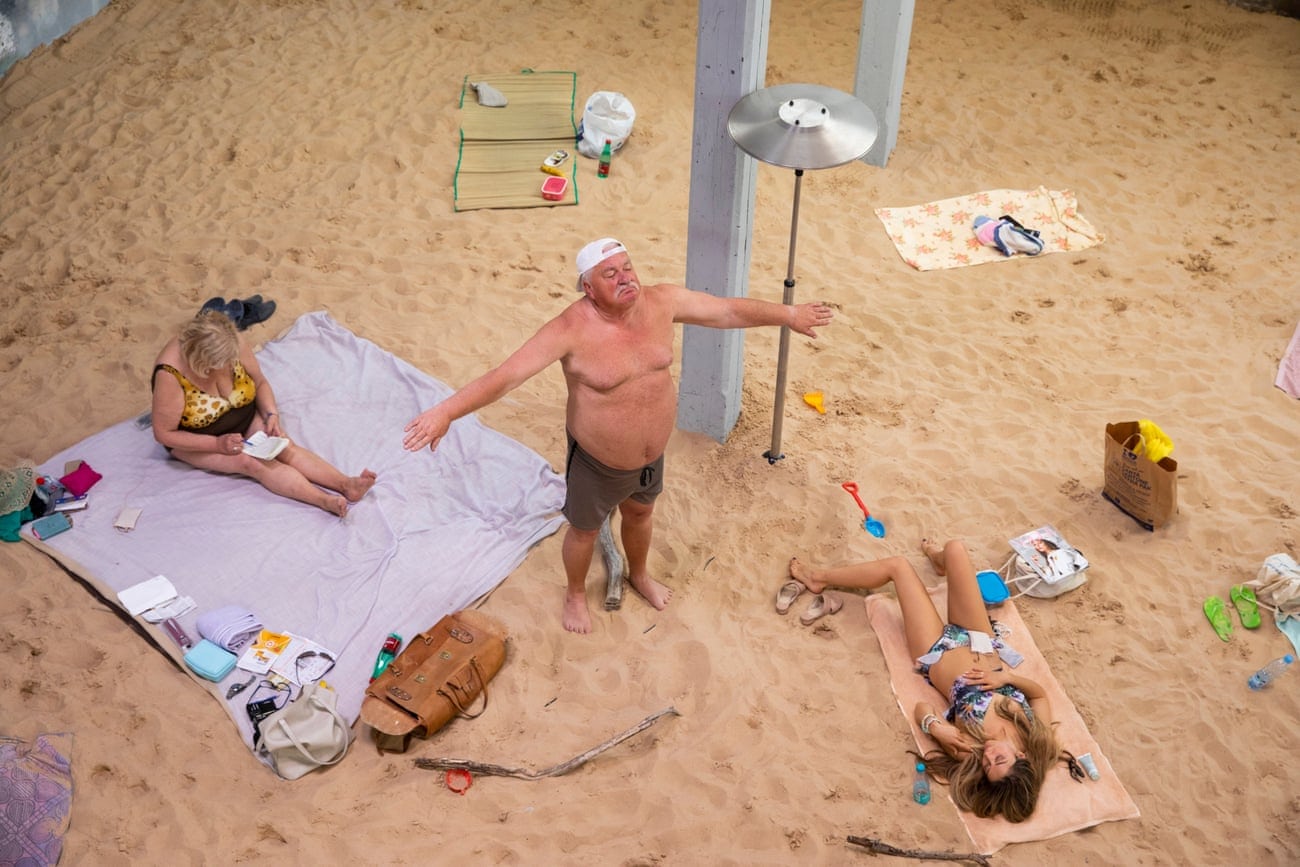
    The winner of the Venice Biennale shows, Lithuanian Pavilion seems to placate us at first. An opera about climate change set at the beach? However, it’s delicate touch is one of the most unique works of art about climate change. Consequently making it one of the most affecting. The performers’ sing about the monotony of their vacations and minor grievances. All the while the sandy sunny holiday hides the destruction taking place backstage. The production is breathtaking. And while it does not attempt to be brutish in its portrayal of the problem; the result, presenting a world not so different from our own.

    Ghana

    Ghana FreedomA rtists: Felicia Abban, John Akomfrah, El Anatsui, Ibrahim Mahama, Selasi Awusi Sosu, and Lynette Yiadom-Boakye

    Curator: Nana Oforiatta Ayim

    Location: Arsenale

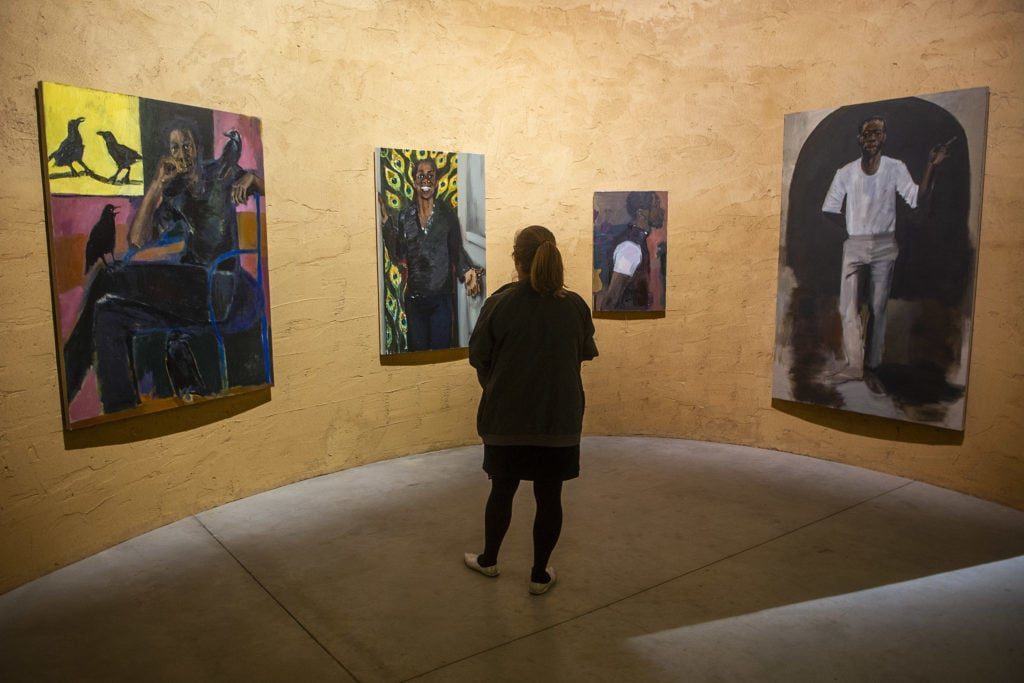
    A visitor looks at an installation by Lynette Yiadom-Boakye in the Ghana Pavillion at the Arsenale during the 58th International Art Biennale on May 07, 2019 in Venice, Italy.

    If the Venice Biennale offered a golden lion for outbreak stars, the Ghana Pavilion would win it. Housing the all-star line up in the newly designed space by architect David Adjaye is the shimmering bottle-cap tapestries by sculptor El Anatsui. Also included are new portraits by painter Lynette Yiadom-Boakye and a sweeping video tracing West Africa’s violent history by John Akomfrah. While these artists will be familiar to the international audience, on the other hand, the exhibition offers, an opportunity for discovery. Gripping black-and-white portraits by Felicia Abban highlights a glimpse of an art historical canon in the process of recalibration. While a video installation tracing Ghana’s abandoned glass factories by the little-known Selasi Awusi Sosuan gestures to the depth of contemporary talent coming out of the country.

    Denmark

    Heirloom Artists: Larissa Sansour

    Curator: Nat Muller

    Location: Giardini

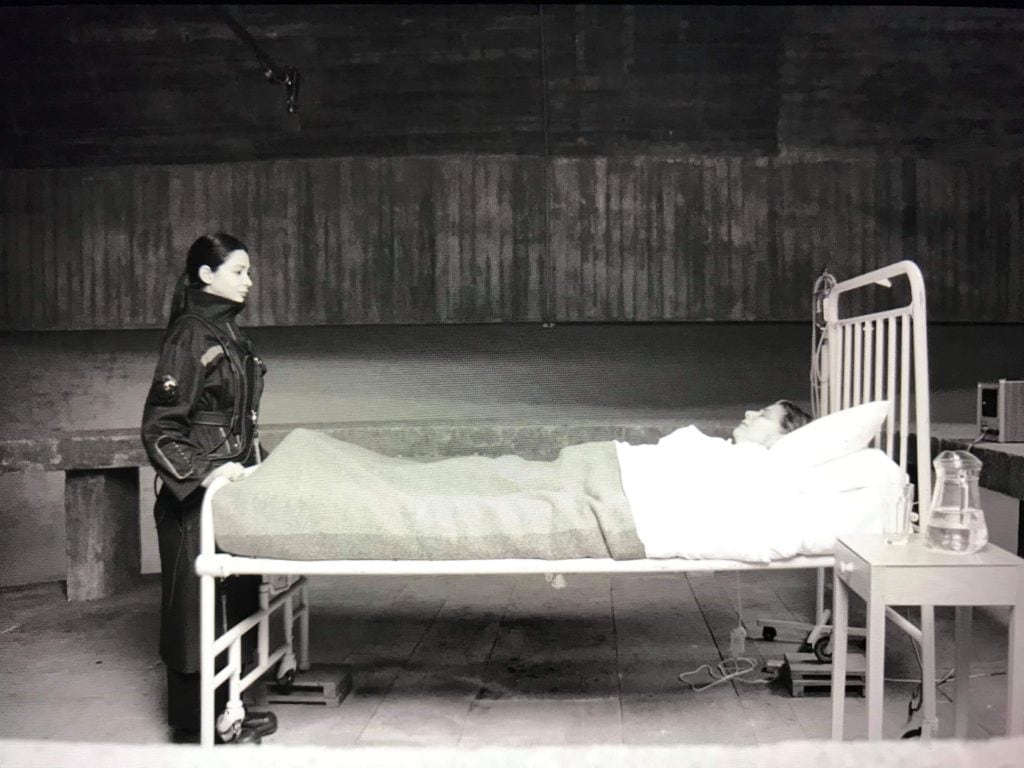
    On the other side of the building, an imposing, monumental black disc stands in a darkened room. While the other half of the Danish pavilion is a theatre. The audience can sit and watch Larissa Sansour’s science fiction film, In Vitro A Monument for Lost Time. The protagonist stands positioned to take the leadership role in her community. The founder escaped the ecological disaster that left the surface uninhabitable. The conversation between the two characters is heartbreaking, complicated by the fight for the survival of the human race. While the lead questions her readiness to lead, she is, resentful that so much of her knowledge is secondhand. Consequently based on the memories of those who remember life before the disaster. But as her predecessor sagely reminds her, “we are all raised on nostalgia, our own experiences blended we others’ we are told.”

Our Content.
Your Inbox

Join thousands of art lovers

Receive art news, market analysis and updates about new artists on the website

By subscribing you agree to receive RDN Arts emails. Unsubscribe at any time. Privacy Policy.