Author: xerkss

  • German contemporary art in the market

    German contemporary art in the market

    The evening auctions of Phillips, Sotheby’s, and Christie’s in October concluded, the only events expected for the global art market in the British capital after the cancellation of the Frieze London and Frieze Masters fairs.


    Given the uncertainties caused by the pandemic, the results were specially monitored as essential parameters for testing the health of an already hard-tested market.

    Faced with this situation, Christie’s and Sotheby’s have developed specific cross-collecting strategies. In particular, they brought together, in a single auction session, modern and contemporary art. The first based in Paris; the second in London.

    Phillips, on the other hand, focused on contemporary art alone in the Berkeley Square venue.
    The results achieved show an overall tonic market for the period, except for Thinking Italian, Christie’s auction dedicated to contemporary Italian art, this year reinforced by valuable design works.

    German contemporary art at auction

    Along with the top lot of awards in both categories (Picasso, Dubuffet, Miró, Banksy, Doig), the protagonist of the evenings was also German contemporary art.

    For some time now the market has shown a keen interest in contemporary German expressionists. Some of whom have become real stars. In particular Gerhard Richter and Sigmar Polke. They were sold by Sotheby’s on 21 October respectively for £ 5,138,700 and £ 1,087,693. Successful also the more historicized Georg Baselitz (Christie’s, 22 October, £ 1,762,500).
    german contemporary art
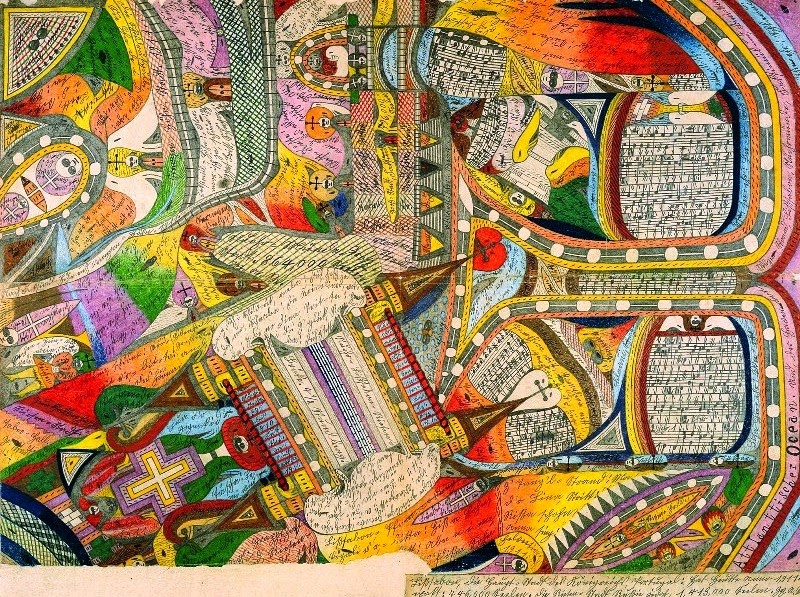
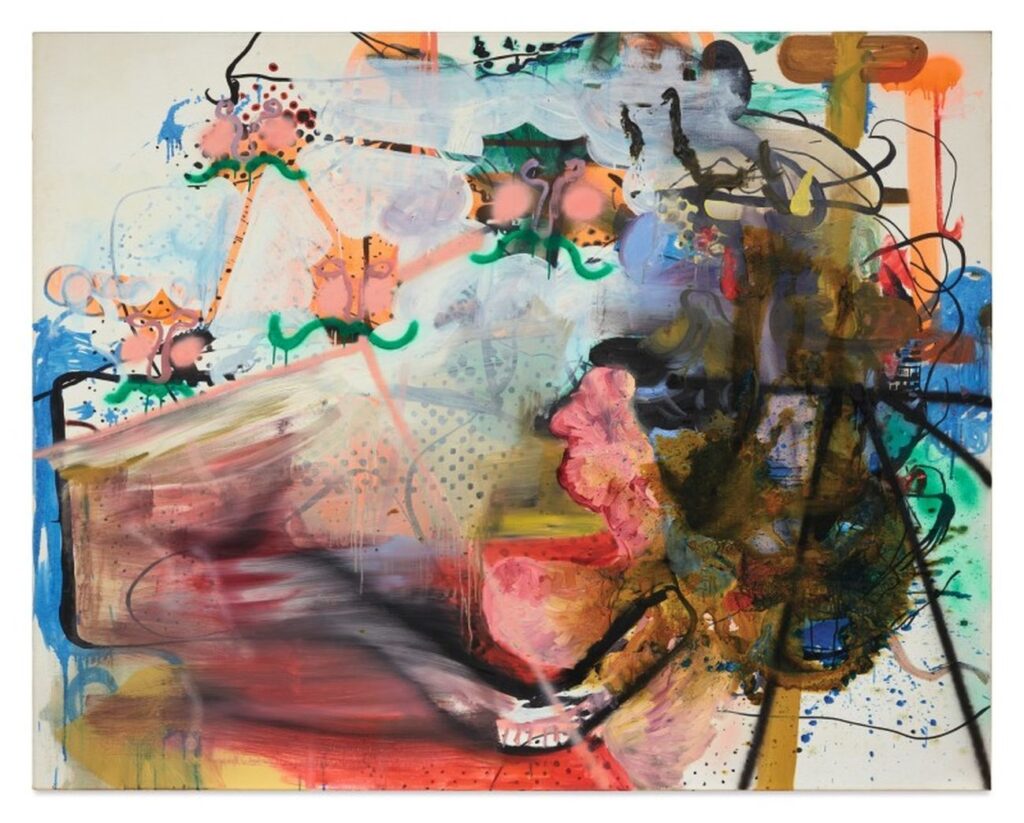
    Albert Oehlen, In der kurve, 1998.

    The evening auctions of this session showed interesting results by other less established artists on the enchantment market. Starting with Albert Oehlen, with two works, Control (2007) and Die Veränderungen (2005), which pass from hand to house. Phillips for £ 475,000 and £ 809,000. Oehlen Untitled (2004), present in the Sotheby’s catalog obtained a good result too with £ 801,500.

    German art succeeding in New York

    With the London auctions concluded, even moving overseas at Sotheby’s New York Contemporary Art Evening on October 28, Germany obtained good feeds. Abstraktes Bild (1989) by Gerhard Richter doubles the auction base, reaching the auction for $ 4,604,899. This way he consolidated his role as the most attractive German artist for the international market.

    Albert Oehlen, with his In der kurve (1998), obtains a new success with $ 1,230,000. That’s certainly a remarkable result for the German artist on the US market.

    As also demonstrated by Sotheby’s New York results, the interest in German contemporary art is increasing. In particular, this is not a European phenomenon exclusively and the results achieved bode well.

  • The System of Contemporary Art

    The System of Contemporary Art

    Galleries, auction houses, fairs, but also exhibitions, museums, and exhibitions of various nature and genre. The system of Contemporary Art is a kaleidoscopic world that can dazzle those that face it for the first time.

    For this reason, we at RDN Arts think it is useful, before embarking on the fascinating journey into the world of collecting, to sit comfortably at the table and study the map of this “middle ground” between culture and economy.


    The Cultural Construction and Consumption of Contemporary Art

    The art market is a global reality in which culture and commerce intertwine in various evolutions, where millions of people, driven by the most varied aspirations, work and move. The system of art has its main offices in New York and London. However, in recent years, it has been spreading in Asia, in particular in China and Hong Kong.

    As much articulate and complicated it may seem, the reassuring thing, at least in this first approach, is that this economic system lyes on the same essential elements. But let’s proceed step by step.

    The Cultural Construction and Consumption of Contemporary Art

    To begin with, it is necessary to make the first distinction between two types of market: the primary one, where works of art are on sale for the first time, and the second one where, instead, they have past buyers. The boundary between these two realities is porous. Also, it often happens that operators working in one may also be present in the other.

    This applies to auction houses that generally include in the catalog works that have already changed hands other times. More and more often, however, they sell works that appear for the first time on the market. That’s the case for Munch’Scream sold at auction for the fantastic amount of 119.9 million dollars.

    However, the merchant remains the main point of reference for collectors. In particular, if it has its own exhibition space: the Gallery.

    The system of contemporary art and the role of Galleries

    As we will see later, the merchants who operate on the primary market behave almost like cultural institutions. In particular, they organize well-curated exhibitions accompanied by catalogs for the artists they represent.

    On the other hand, the role of the Gallery, historically, goes beyond that of the simple sale of work. In particular, they are real centers of cultural dissemination. It is they, we must not forget, who contributed to the affirmation of Impressionism, Cubism, and many other avant-garde movements. Different is the matter for secondary merchants, but we will talk about this at another time.

    The system of contemporary art and the role of Galleries

    Closely connected to the world of galleries is that of art fairs. There are about eighty of them all over the world, even if the really important ones are much less. The fairs give the great opportunity to have galleries from various parts of the country or the world. Galleries that a person could hardly visit directly in their home.

    Beloved and hated, the Auction Houses entered the world of contemporary art at the end of the nineties. However, operating mainly on the secondary market, they do not fail to make forays into the primary.

    Then there are the Art Consultants: their main task is to guide the collector in his choices and to give him access to works that, in a very competitive market such as that of contemporary art, would otherwise be unreachable.

    To date, however, the art system reserves a prominent place for online galleries, which, especially in this delicate historical period, represent the most direct channel that unites the works with collectors.

  • Nudity in art: modern & contemporary nude paintings

    Nudity in art: modern & contemporary nude paintings

    The nude is the representation of the human body in all artistic disciplines. Nudity in art (in painting, sculpture, and more recently in photography) has generally reflected, with some exceptions, the social levels of aesthetics and morality of the time.


    History of nudity in Art

    In fact, it is the only theme that has accompanied us from the beginning, from the dawn of civilization. The naked human body in figurative art has origins in prehistory, to then unfold over the centuries as one of the major themes of art.

    Some authors consider Goya’s work as the first nude not inspired by literary or mythological narration. Already in the second half of the 1700s, Boucher and Fragonard, portraited nudes removed from the myth.

    Nudity in art: modern & contemporary nudes paintings
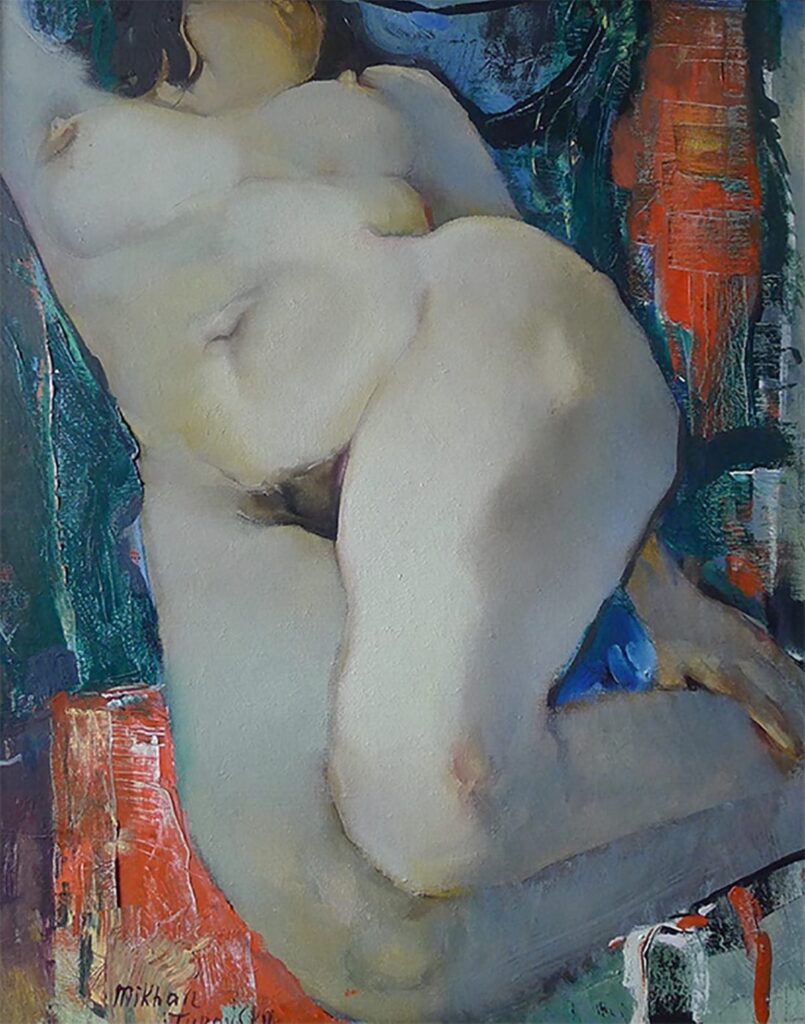
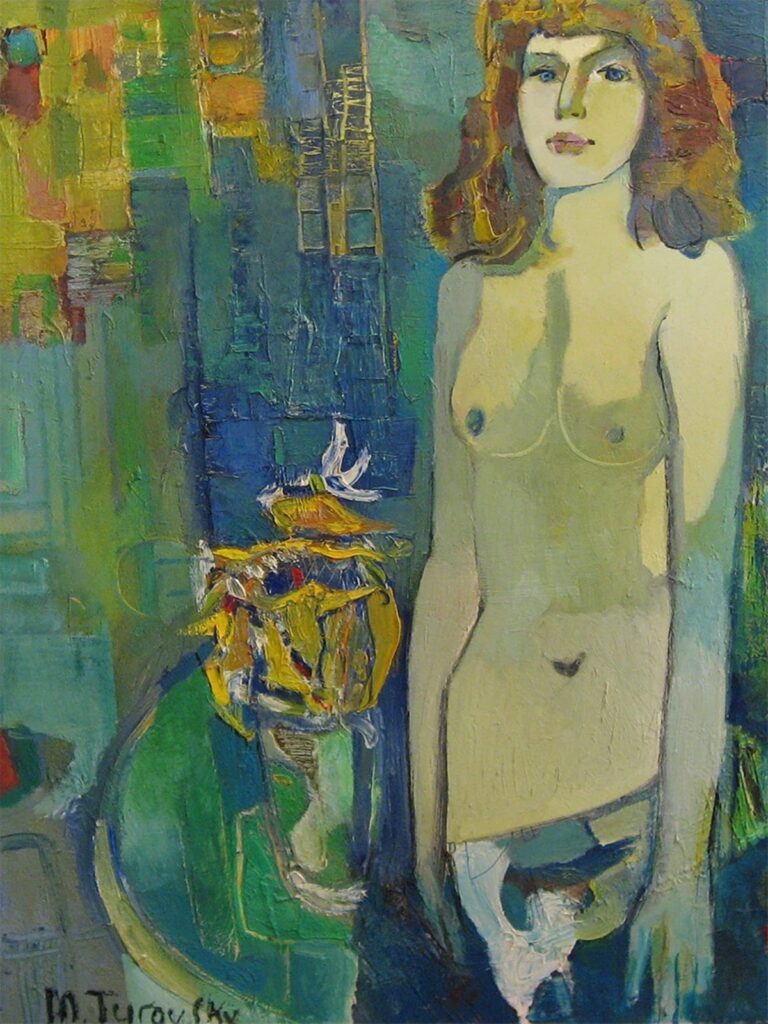
    Mikhail Turovsky, TORSO

    Emile Zola also finds that Manet’s painting is morally unpresentable as other critics believe Baudelaire’s The Flowers of Evil vulgar.

    The roots lie, however, in Renaissance culture. They were hence brought to the modern, as modern is the pictorial technique adopted that laid the foundations for impressionism.

    History of nudity in Art
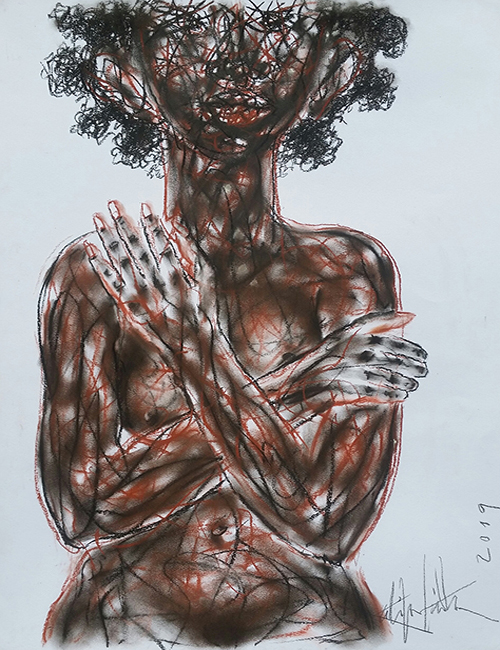
    Salifou Lindou, JEUNE FEMME, 2019

    With the twentieth century, the artistic means of expression multiplied. Cinema, photography, web, photoshop, and the border between artistic nude, eroticism, and pornography is getting thinner. Many artists play on this very border, especially in photography.

    Contemporary nudes

    Even today, in a third millennium that has broken down all aesthetic barriers and the concept of transgression, artists are confronted with the theme of the nude that from ancient times to the modern era has seen illustrious exponents in painting, sculpture, and photography.

    In contemporary art, once photography appeared among the major arts, it is not difficult to trace the complex and fertile legacy of previous and modern painting. Especially if one consider the extraordinary use of light and chiaroscuro in the first planes of Mapplethorpe, for example.

    Contemporary nudes
    ma desheng, #1

    The charm of the body, however, is decidedly omnipresent in contemporary art. A tour of any group of young talents is enough to notice that subjects of nudes swarm everywhere; it seems that the female or male body without veils that is, after centuries of specific iconography, always attracts.

    Besides the languages ​​of new technologies and the performance that today sees the contaminations between art, theater, and dance, contemporaries continue to experiment attracted by the irresistible magnetism of the body.

    Breaking the taboo

    Today, rather than arousing desire, contemporary nudes seem to want to break the taboos. Especially those surrounding the body, defying the traditional morals that still govern society.

    Today, rather than arousing desire, contemporary nudes seem to want to break the taboos. Especially those surrounding the body, defying the traditional morals that still govern society.
    Mikhail Turovsky, GIRL AND BOUQUET

    Often tender, sensual, and completely uncensored, these representations are a tool. They serve for breaking social taboos for exploring the themes of life, death, and desire.

    However, on the other hand, the Cubist or futurist nude is entirely different. It is made of schemes and composite surfaces, devoid of pathos and rich in concept, and therefore naturally classic; Picasso’s naked prostitutes are dummies in front of the terrible and disturbing gaze of Kirchner’s Marcella.

    Furthermore, the development in the last thirty years of installations, montages, stylistic assemblages, and performances, has included an exuberant acting component in the context of art exhibitions.

  • Exploring the Art Brut

    Exploring the Art Brut

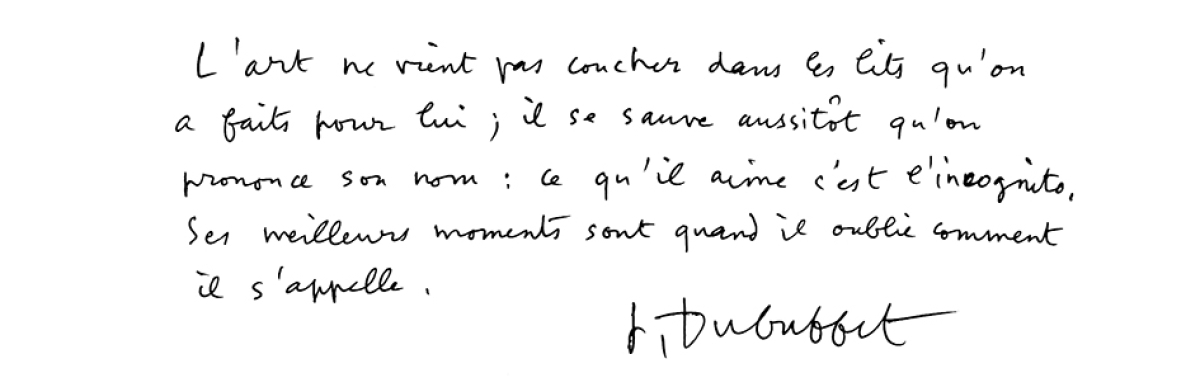
    The so-called Art Brut represents something truly unique among the various artistic movements. A form of visual expression that shuns all known canons and focuses on the artist’s only idea. To fully understand how the phenomenon is born and how it develops, we must start from Jean Dubuffet, the artist who coined the term to describe “an entirely pure, raw artistic operation that the creator fully reinvents in all its phases, as spurred uniquely by his own impulses.”


    The Concept behind the Art Brut

    The creators that fall within this definition are singular characters, who deny the impositions and values ​​of the community. These are often self-taught painters and sculptors for whom artistic recognition is not important. In particular, these artists do not create for fame or money. Their art is aimed at itself, at a pure expression of their inner world.

    Precisely because their creative world knows no limits and impositions, they are not oriented towards any particular style. Or rather, they don’t feel adhered to any artistic tradition exactly because in this way they are free to give their creations singular figurative meanings.

    The Concept behind the Art Brut
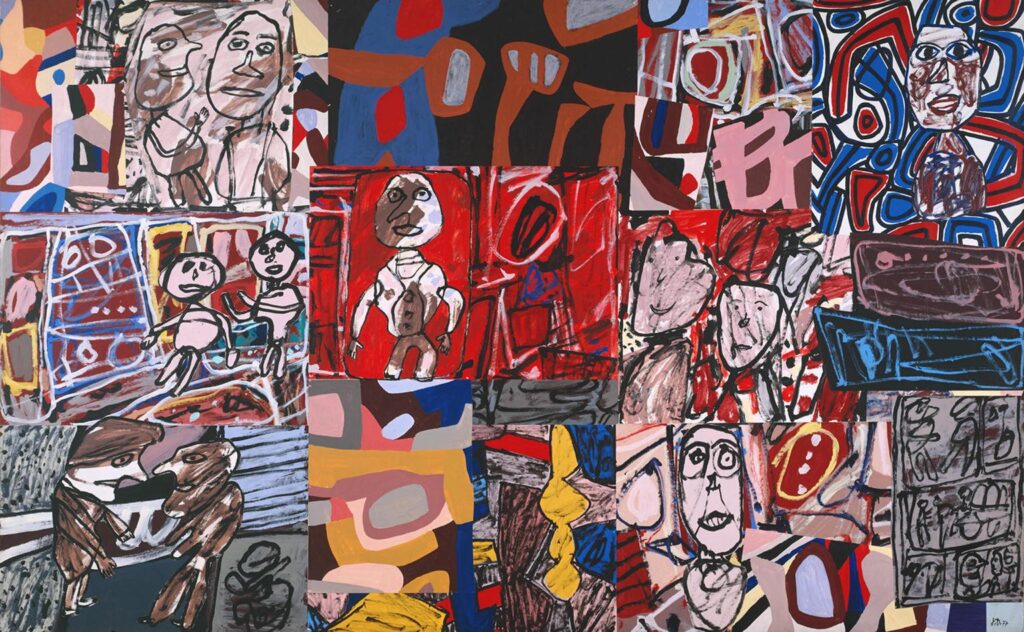
    Vicissitudes by Jean Dubuffet 1977

    This type of art, also called “outsider art” is defined by Jean Dubuffet in this way:

    “By this [Art Brut] we mean pieces of work executed by people untouched by artistic culture, in which therefore mimicry, contrary to what happens in intellectuals, plays little or no part, so that their authors draw everything (subjects, choice of materials employed, means of transposition, rhythms, ways of writing, etc.) from their own depths and not from clichés of classical art or art that is fashionable. Here we are witnessing an artistic operation that is completely pure, raw, reinvented. In all its phases by its author, based solely on his own impulses. Art, therefore, which is manifested the sole function of invention, and not those, constantly seen in cultural art, of the chameleon and the monkey.”

    Art By Medically Insane Patients

    In 1919 Karl Jaspers in Psychology of worldviews describes madness as a “particular” form of existence. Three years later Jaspers wrote a famous essay on Van Gogh. In this he affirms that schizophrenia unleashed previously inhibited forces in the Dutch artist, resulting in “a plus of creativity”. As if to say that the talent of an artist, thanks to madness, reaches the heights of a genius if not more intense, certainly of special authenticity.

    Art By Medically Insane Patients
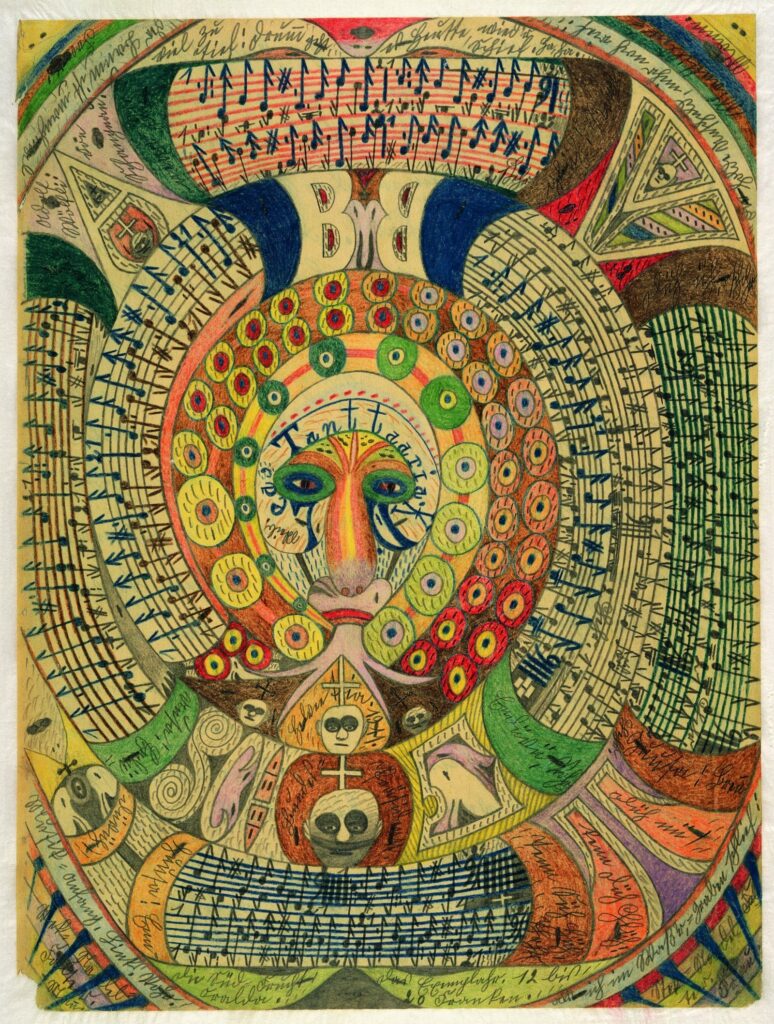
    Untitled by Adolph Wölfli

    The relationship between mental illness and creative expression has a long history and there is still much to be explored. However, a remarkable documentation work was that of Dr. Morgenthaler on the expressive creativity of Adolph Wölfli.

    Wölfli was a psychiatric patient at the hospital in Waldau but also a prominent exponent of Art Brut. At the hospital, Wölfli began drawing, writing, and composing music. He worked day and night until 1930, the year of his death.

    Wölfli was a psychiatric patient at the hospital in Waldau but also a prominent exponent of Art Brut.  At the hospital, Wölfli began drawing, writing, and composing music.
    Untitled by Adolph Wölfli

    In thirty years Wölfli creates 1300 drawings, notebooks of writings, a biography entitled The legend of Saint Adolfo: his is a manic and “necessary” production.

    His works are almost always mandalic, have a center from which the whole composition radiates, as if to restore an order now lost in his life. In addition to graphic elements, he also inserts lyrics and musical notes in his creations.

    Compagnie de l’Art Brut

    In 1948, along with others, Dubuffet and Andre Breton founded the Compagnie de l’Art Brut. Known as the Collection de l’Art Brut, the series is regularly lent for exhibitions at art museums around the world. The collection now contains thousands of works and is based in Lausanne.

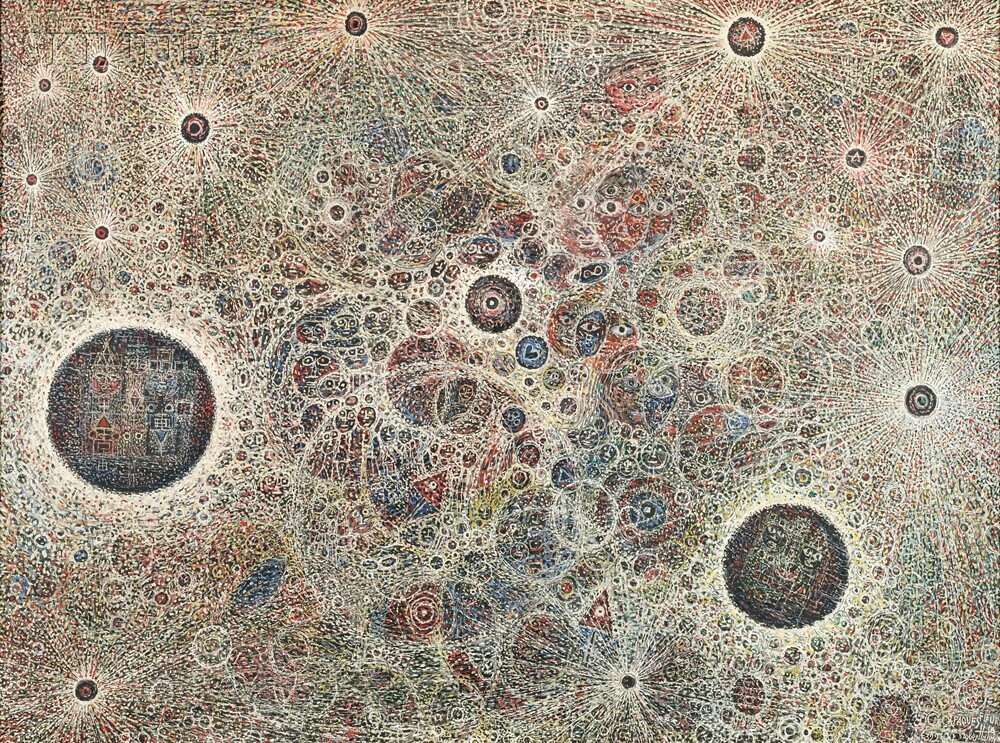
    Pacques Fleuri by Robert Tatin

    Well known Art Brut artists include the painters Henri Rousseau (1844-1910), Augustin Lesage (1876-1954), Joseph Crepin (1875-1948), sculptor Robert Tatin (1902-83), the painter Gaston Chaissac (1910-64); and the junk artist Chomo (Rene Chomeaux).

    Today it is evident that this type of art is connected to more canonical artistic movements, which however preserve a certain intuitive connotation. It seems that Art Brut partially influenced Basquiat himself and the exponents of Art Informel and Abstract Expressionism.

  • Famous Art Collectors

    Famous Art Collectors

    People have been collecting art since ancient times and keep collecting for several reasons. In this article, we are going to look at the most famous art collectors of all time, from the veritable roots of phenomenon till today!


    Famous art collectors of the past

    Among the representatives of the first collection, there are the names of truly illustrious characters! The history of collecting is incredibly rich in prominent personalities who have made a great contribution to the ongoing history of art.

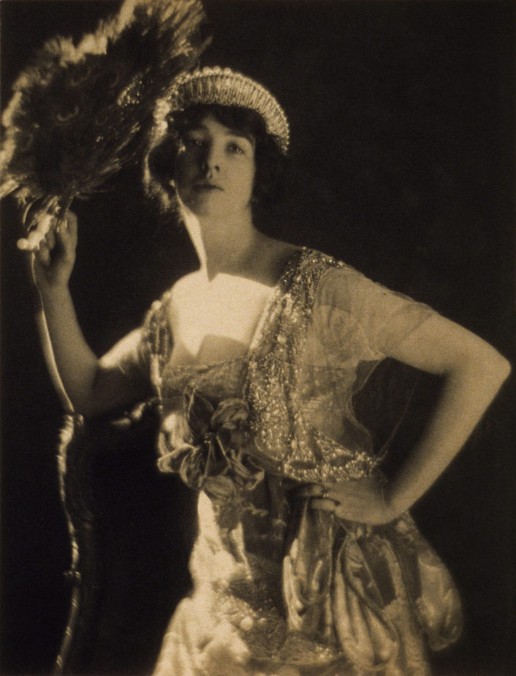
    Gertrude Vanderbilt Whitney – The American Art Collections

    Famous art collectors of the past

    Gertrude Vanderbilt Whitney was an American sculptor and one of the most influential art collectors in history. She was responsible for the establishment of the Whitney Museum of American Art in 1931. Gertrude became a central figure in the elite of the American cultural landscape not only for her ability in the artistic analysis but also for her sculptural production. Daughter of the Vanderbilt family, she is among the female art patrons who made history.

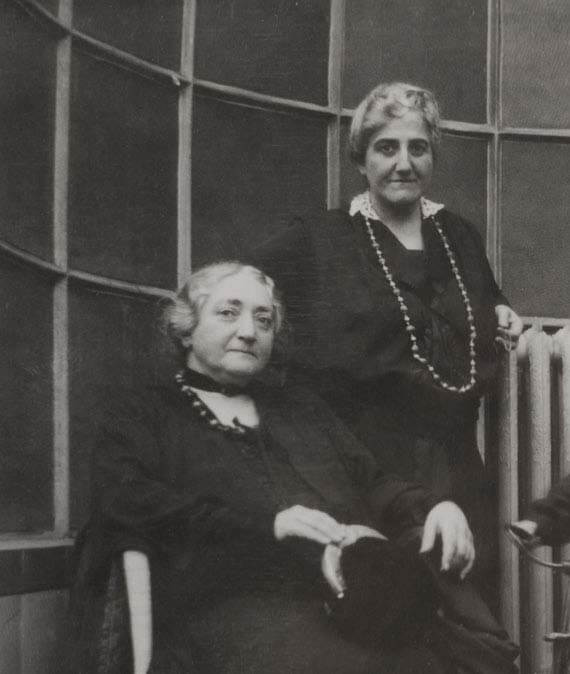
    The Cone Sisters – Modern French art collection

    The history of collecting is incredibly rich in prominent personalities who have made a great contribution to the ongoing history of art as the Cone sisters

    Claribel and Etta Cone created one of the finest galleries of French modern art in America in the early twentieth century. Daughters of Jewish immigrants, the two sisters began collecting works of art in 1898. If Etta preferred more canine artists, on the other hand, Claribel loved Cezanne’s avant-guarde.

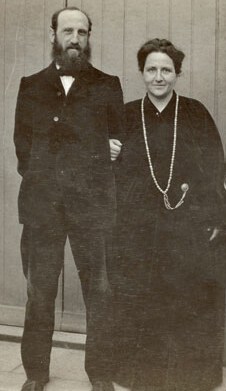
    Gertrude and Leo Stein Belle Époque

    Gertrude and Leo Stein distinguished themselves as true luminaries of the culture of the time. Their Paris home soon became one of the most popular lounges for Parisian intellectuals

    During the Belle Epoque period, the brothers Gertrude and Leo Stein distinguished themselves as true luminaries of the culture of the time. Their Paris home soon became one of the most popular lounges for Parisian intellectuals. Just in that place, the two brothers started an impressive art collection. Both had a notable understanding of art, and they would often buy pieces right out of the studios of avant-garde artists. Among others, they collected works by Renoir, Delacroix, Degas, Manet.

    Famous collectors of today

    There are several ways of collecting art. Fortunately, solutions can be found that satisfy the most varied tastes as well as the different budget needs. Among the best-known art collectors today there are some great showbiz stars such as:

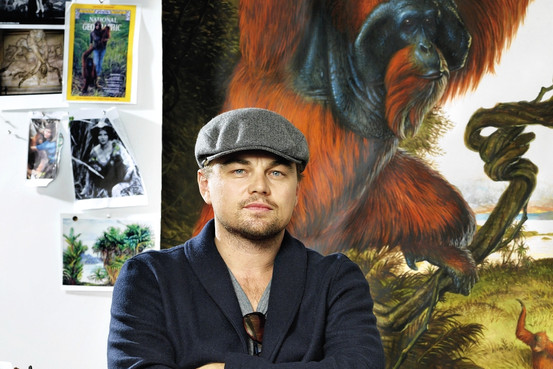
    Leonardo di Caprio

    Leonardo di Caprio is a true fan of modern art. In particular, the actor co-hosted LACMA's glittering Art + Film Gala.

    The contemporary movie star is a true fan of modern art. In particular, the actor co-hosted LACMA’s glittering Art + Film Gala. His collection brings together a large number of contemporary artists, with a remarkable focus on emerging ones. Among the actor’s most conspicuous art purchases is an unfinished painting by Takashi Murakami bought for $ 700,000.

    Sean Combs

    Not many are aware of it, but the world hip-hop star Sean Combs got into serious art collecting.

    Not many are aware of it, but the world hip-hop star got into serious art collecting. In fact, he actually made the headlines when he brought his entire entourage with him into the Gagosian Gallery booth at Art Basel Miami in 2011.

    David Geffen

    Famous collectors of today David Geffen

    David Geffen is an American record and film producer, founder of “Asylum Records” and “Geffen Records”. Regardless, he is also famous for his impressive art collection, which has been estimated to be worth as much as $ 1.1 billion. His collection includes works by Jackson Pollock and Mark Rothko.

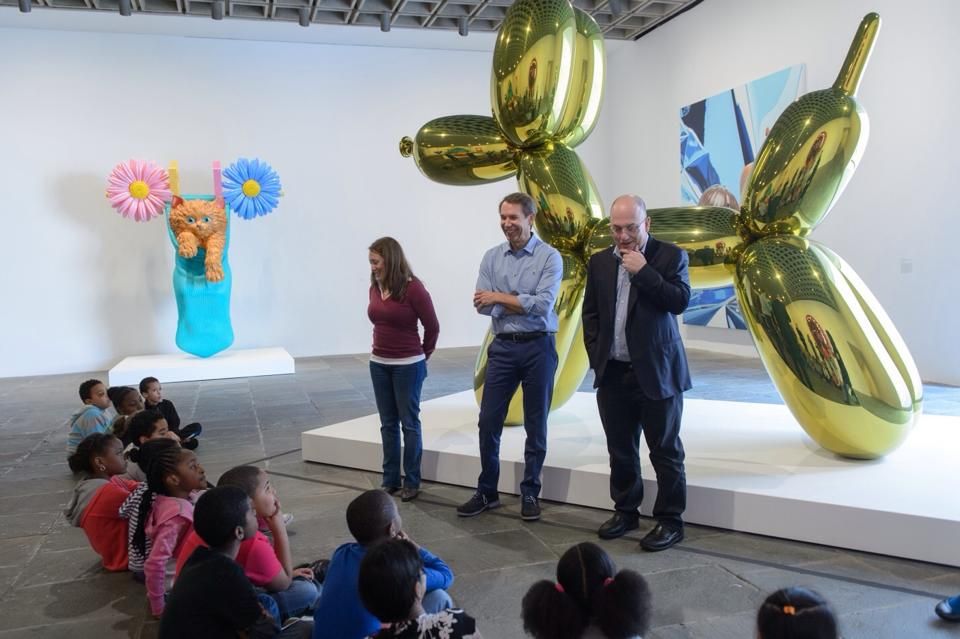
    Steven Cohen

    Steven Cohen is among the world-famous art collectors. He started his art search in 2000.

    Successful investor, hedge fund manager, and philanthropist, Steven Cohen is among the world-famous art collectors. He started his art search in 2000. His collection is impressive and counts a large number of contemporary works from all over the world.

  • Paul Signac, the painter of water

    Paul Signac, the painter of water

    Even today, Paul Signac is still a trend in the art market. Some of the painter’s creations were, in fact, ready for a charity auction held in collaboration with the charity Every Mother Counts.


    The Sotheby’s auction held from 1 to December 10 focuses entirely on Impressionist and modern artists such as Paul Signac, Joan Miró, Henri Manguin, and Armand Guillaumin. But why does Signac continue to make art lovers dream after many years?

    From Impressionism to Pointillism

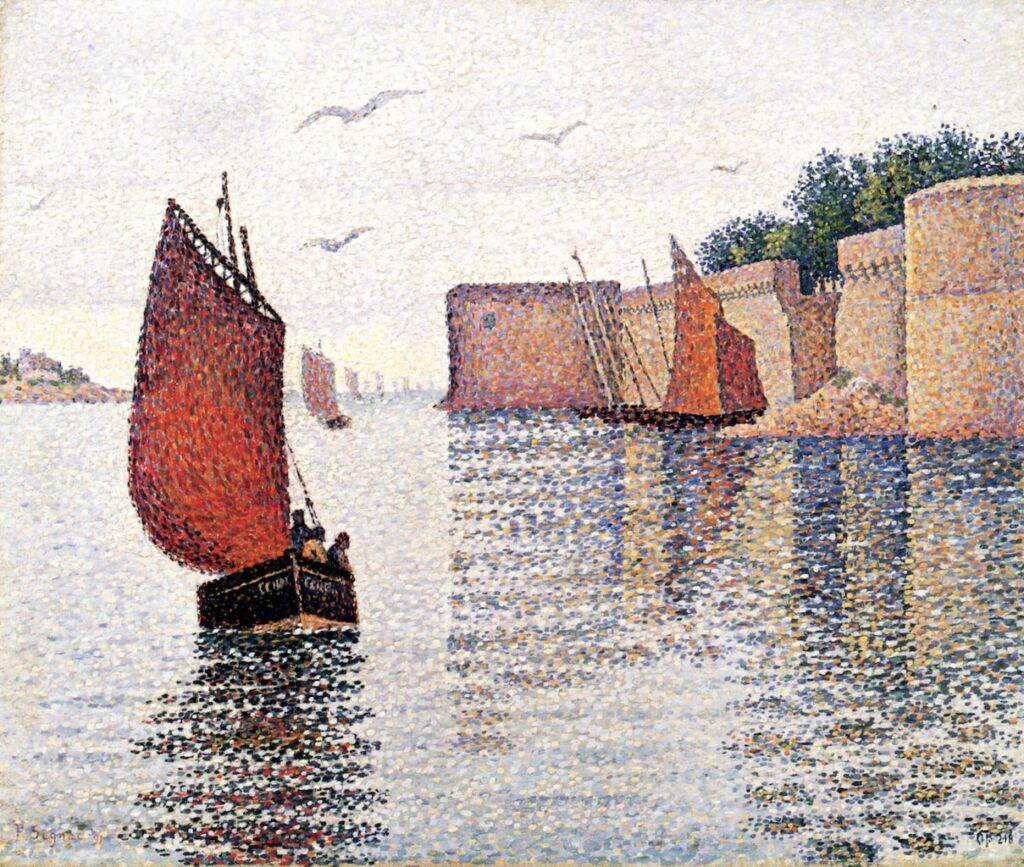
    Paul Signac is one of the greatest protagonists of late nineteenth-century art. His artistic career’s most emblematic works show his initial adherence to Impressionism. He later abandoned the technique, giving life to “Pointillism” together with his friend Georges Seurat.
    In addition to the so-called Neo-Impressionist style with which he is known throughout the world, Signac, will also show interest in other artistic currents. He will, in fact, experiment with different techniques, among which he will prefer watercolor.

    Paul Signac is one of the greatest protagonists of late nineteenth-century art. His artistic career's most emblematic works show his initial adherence to Impressionism
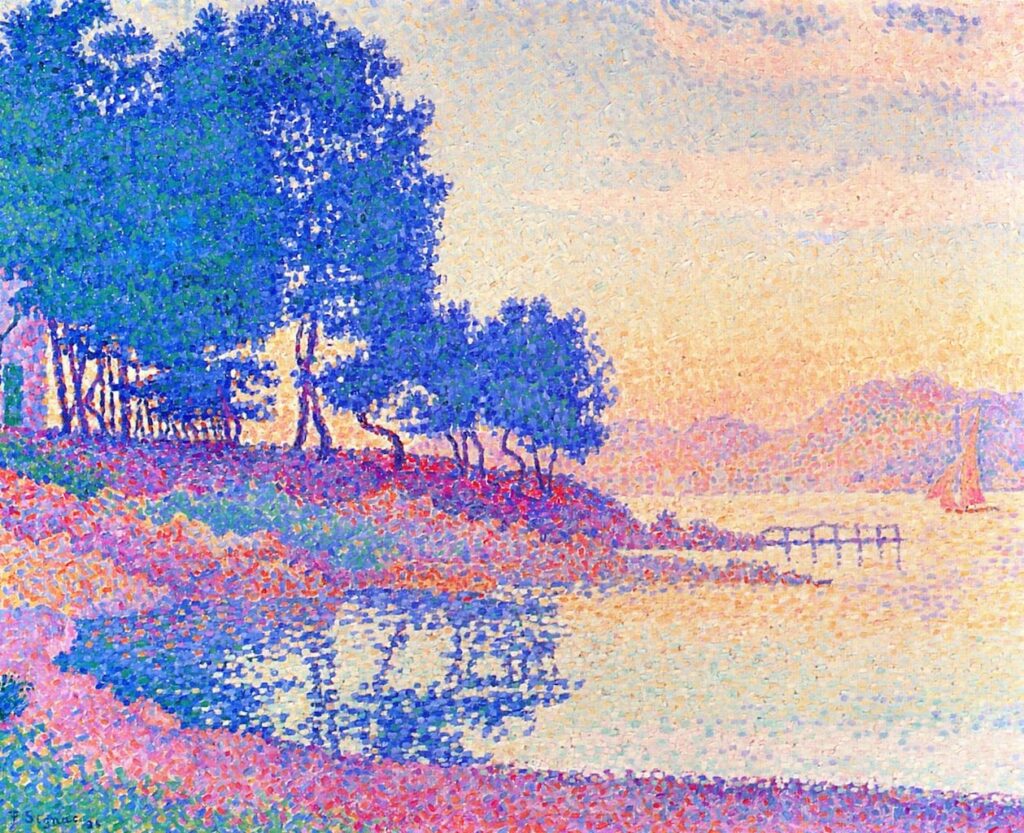
    An Cove in Saint-Tropez, 1926.

    That of the dots is an undoubtedly revolutionary technique that only a few were able to understand. The pointillists treasure the theory enunciated by Eugène Chevreul on the “law of simultaneous contrast of colors”. According to it each color conditions the one that is close to it, sending its own complementary back to it. It will be another artistic revolution. In this one paints by placing on the canvas, touches of different colors and separate color points.

    Like Seurat, Paul Signac projects his painting towards a scientific study to calculate the color combinations. His purpose is to create maximum brightness accurately
    Concarneau; Sardine Boat and the Old City, 1891

    Like Seurat, Paul Signac projects his painting towards a scientific study to calculate the color combinations. His purpose is to create maximum brightness accurately. Both use the simultaneous contrast of colors, which does not involve any mixing. However, it uses a variety of the same tones, especially the complementary ones.

    Paul Signac’s life: the artistic vocation

    Born in Paris on November 11, 1863, to a wealthy family of merchants settled in Asnieres-sur-Seine, Paul Signac will manifest his passion for art in the heart of Montmartre. Here in fact the family will move a few years after his birth. In 1879 he began attending the cabaret “Le Chat Noir,” and in the same year, he visited the fourth Impressionist exhibition. In it, he discovered Caillebotte, Cassatt, Degas, Monet, and Pissarro. His artistic vocation begins to send him clear signals. However, Gauguin invited him to abandon painting by uttering very harsh words: “Don’t copy here, sir”.

    Overwhelmed by a profound and irresistible attraction for painting, he began to attend exhibitions from that moment on. He began studying the works of the Impressionists, becoming particularly passionate about Jean-Baptiste Guillaumin’s paintings.

    Even today, Paul Signac is still a trend in the art market. Some of the painter's creations were, in fact, ready for a charity auction held in collaboration with the charity Every Mother Counts.
    Harbour Scene, 1886

    In those same years, his love for navigation also blossomed, thanks to the painter Gustave Caillebotte. This theme will be a decisive part of his artistic production. Together with his friend Georges Seurat, he will contribute to the birth of Pointillism to which Camille Pissarro will adhere, albeit for a short time.

    In 1887 he became friends with Vincent Van Gogh. In particular, he accompanied the Dutch painter in his search for color in Asnières. A place where he loved to paint en plein air.

    His artistic maturity reached his artistic maturity, but Signac, does not stop. He deepens his research, which he will collect in an essay dedicated to his friend Seurat “From Eugene Delacroix to Neo-Impressionism”. Published in 1899, the book offers an excellent synthesis of the artistic research path carried out together with his friend and will be a significant source of inspiration for many artists.

  • Ariadne’s Afternoon: new world record for De Chirico

    Ariadne’s Afternoon: new world record for De Chirico

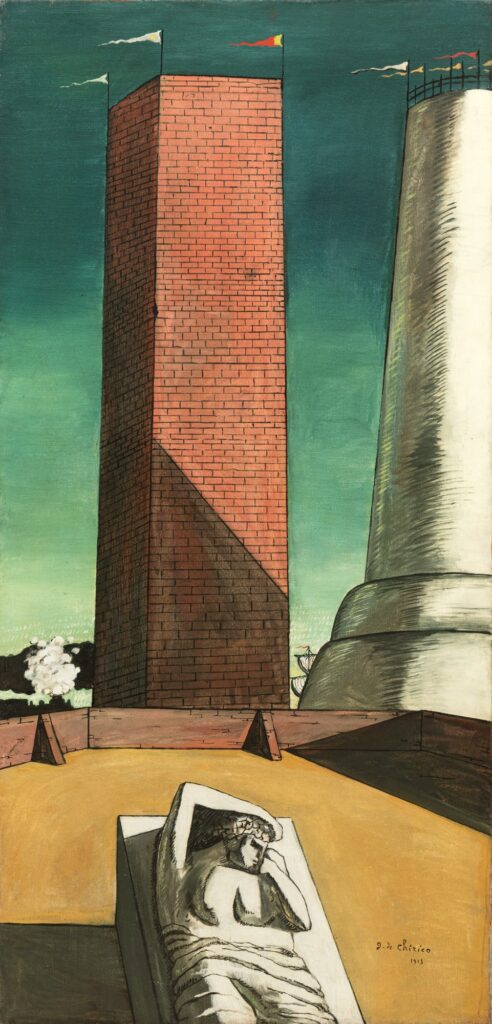
    New world record for De Chirico: his painting “Ariadne’s Afternoon” sold at auction in New York for 15.9 million dollars.


    Ariadne’s Afternoon sold for $ 15.9 million

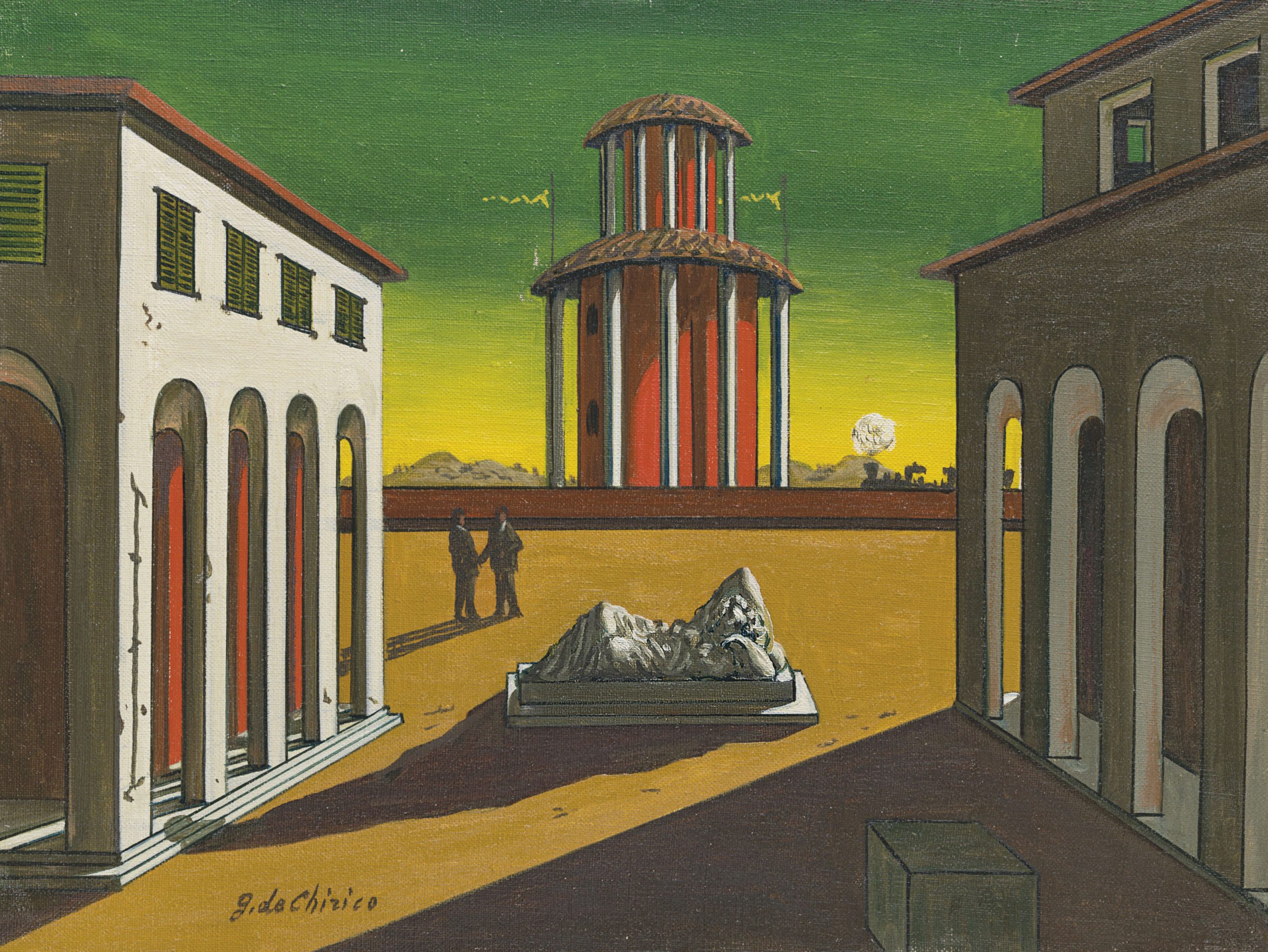
    The leader of metaphysical painting, Giorgio de Chirico (1888-1978), sets a new world record. “Ariadne’s Afternoon” of 1913 is one of his first masterpieces. It was sold for $ 15.9 million at Sotheby’s modern and impressionist art auction in New York. The painter’s award for a record figure came after nine intense minutes of battle with bids between two collectors. The painting was first on the market with an estimate of 10 million dollars. It is part of the eight canvases that make up the first series by De Chirico, between 1912 and 1913. Also, it is among the few still in private hands.

    Ariadne’s Afternoon: new world record for De Chirico

    Five of the paintings that make up the series are in museum collections. Among them the Metropolitan Museum of Art in New York and the Philadelphia Museum of Art. While the remaining three, including the one awarded by Sotheby’s, are present in private collections. “Ariadne’s Afternoon” has a large-scale vertical format and it is the only example depicting the Ariadne myth’s emblematic ship.

    De Chirico’s art, a representation of mystery, loneliness and disturbing muses that observe you despite having no eyes, was at the basis for surrealism, whose first manifesto dates back to 1924.

    News from the market

    And so, Ariadne’s Afternoon (1913) snatched the primacy from Il Ritornante (1919), which was sold by Christie’s for 14.1 million dollars in 2009. In reality, another Giacometti’s work, the Grande Femme I, billed as the most expensive lot of the night (estimate: $ 90 million). However the sculpture was purchased before the auction through a private sale, and the price was not disclosed.

    Other issues of the evening include Man Ray’s Black Widow (Nativity) (1915), “the epitome of museum quality painting”, $ 5,779,200. René Magritte’s Ovation (1962) then reached $ 14,052,000, while a very poetic Rêverie de Monsieur James (1943), from the collection of actress Sandra Moss, sold for $ 5,089,800. Great anticipation also for Vincent van Gogh‘s masterpiece Fleurs dans un verre (1890). It went for $ 16,235,100, as well as the Brooklyn Museum’s starring paintings, which totaled $ 7.2 million. Among them, Claude Monet’s Les Îles a Port-Villez (1897), surpassed the initial estimate of between $ 2.5 million and $ 3.5 million and till $ 3.8 million ($ 4.6 million, including commissions).

  • Artist we love: Scott Kahn

    Artist we love: Scott Kahn

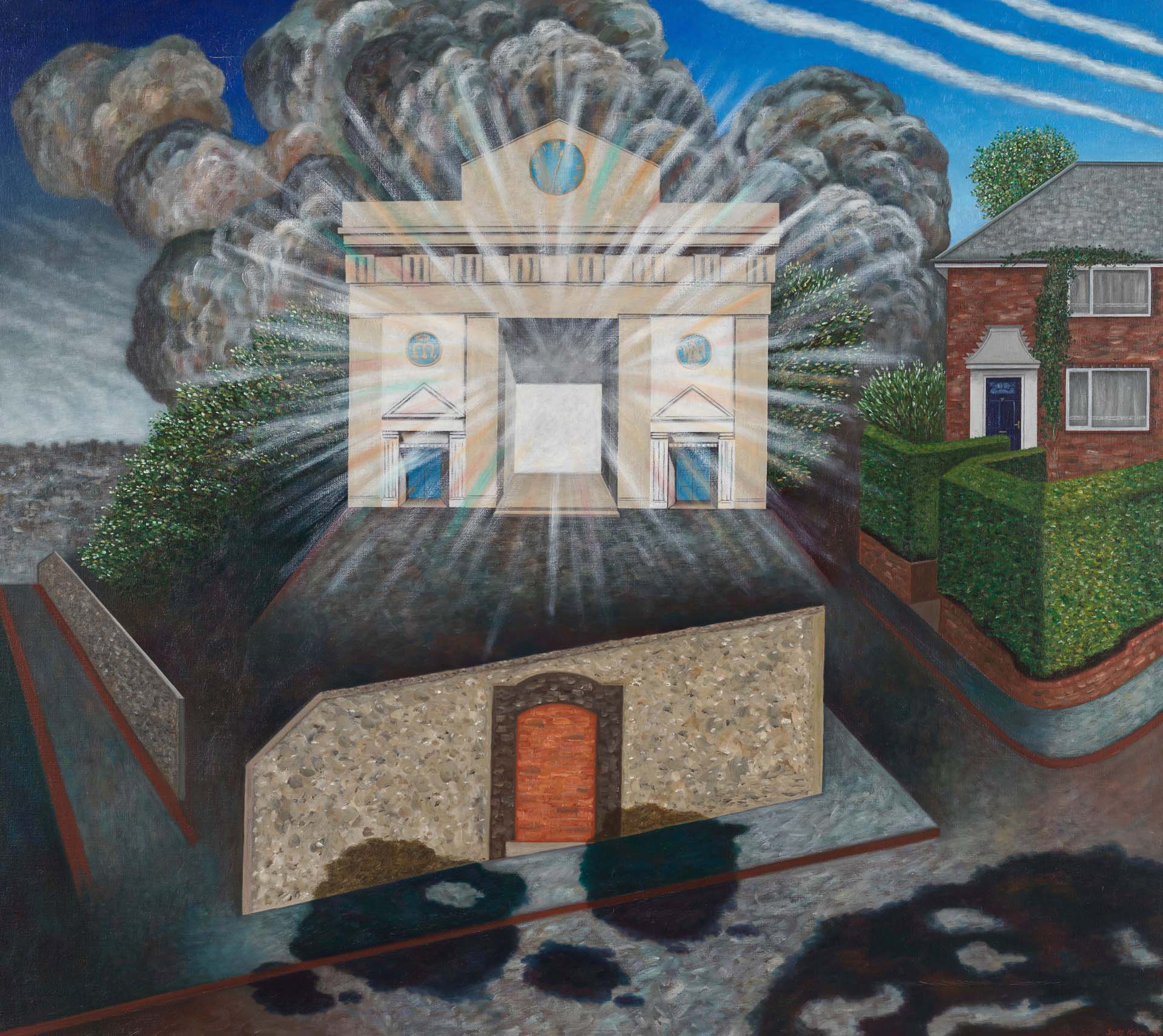
    Scott Kahn is undoubtedly an artist we love! Among the most notable names in contemporary American art, Kahn has created an artistic and expressive language, unlike any other. His painting is dreamlike, imaginative. The signs of his artistic personality find inspiration in the landscapes, in a diversity of layers of colors that result in vivid nuances full of depth.


    Fantasy painting by Scott Kahn

    Fantasy painting by Scott Kahn
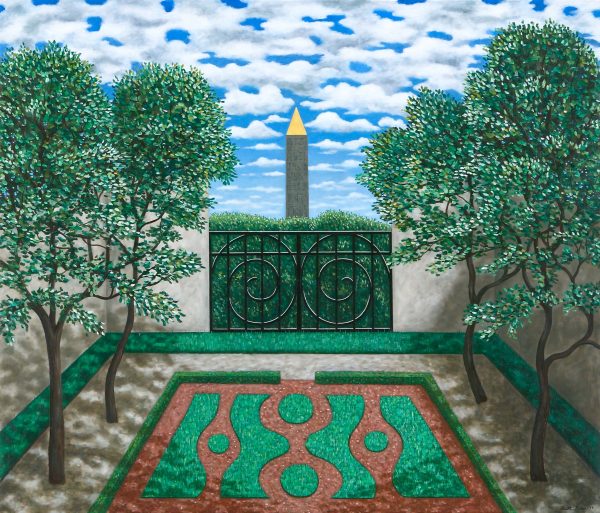
    OBELISK, 1999 SCOTT KAHN

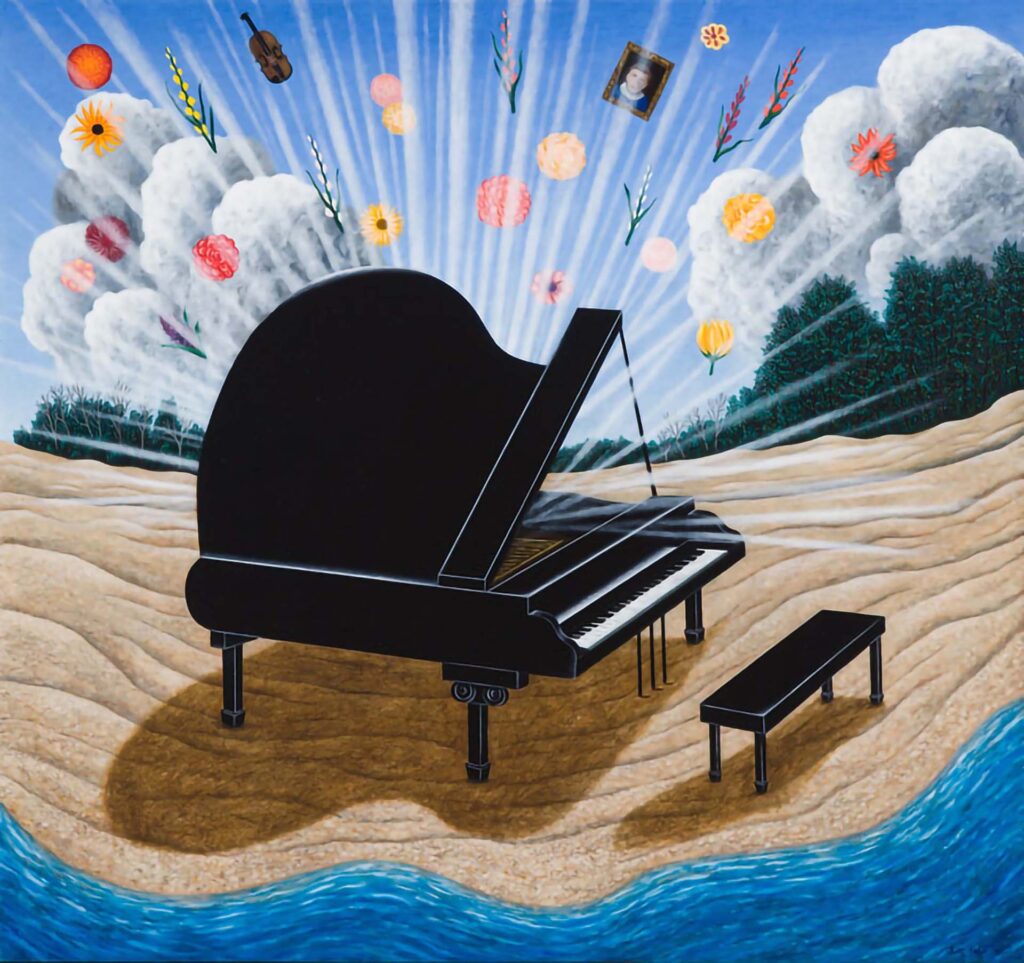
    Kahn’s painting has gone through different pictorial yields over time. Having ranged from minimalism, to abstraction, to conceptual art, the Springfield artist now dedicates himself to representations with symbolic content. His is a language full of rhetorical figures. What animates his work is instead an inner quest that seeks between the balance of nature and the subconscious mystery.

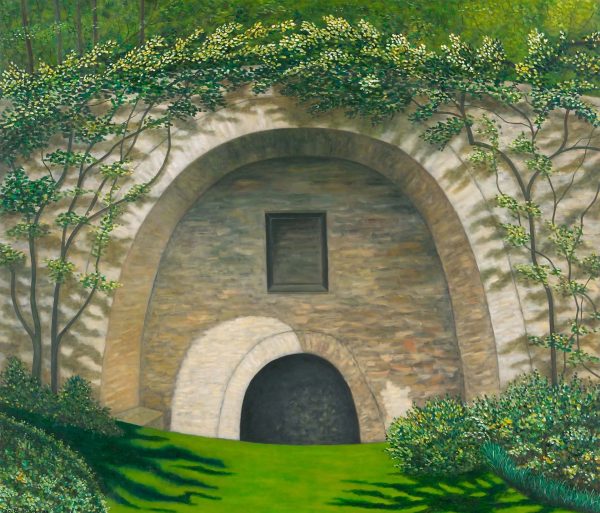
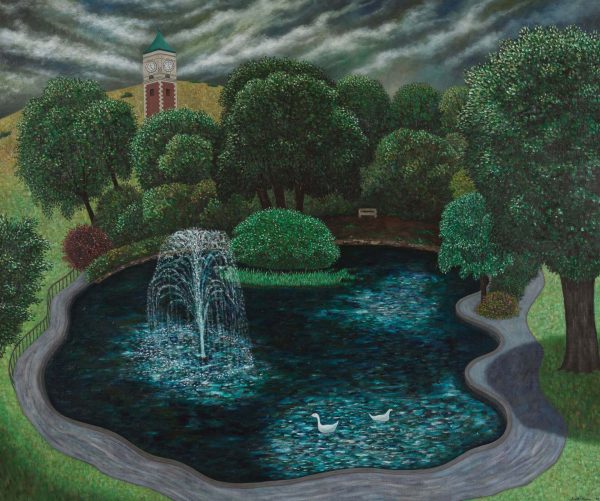
    This is why his paintings look like real dreams on canvas. Objects are stripped of their usual connotations. In fact, Kahn creates new associations, creating a new map of meanings that fascinates and intrigues the viewers of his works. It is precisely in these dreamlike overtones, in these surreal scenes, that the viewer begins a journey of discovery. Kahn completely immerses the viewer in inner exploration like an adventurer through the soul’s hidden spaces and the unconscious.

    Kahn's painting has gone through different pictorial yields over time. Having ranged from minimalism, to abstraction, to conceptual art, the Springfield artist now dedicates himself to representations with symbolic content
    PIANO ON THE BEACH, 1996 SCOTT KAHN

    Although landscapes are among the protagonists of his artistic production, Kahn sees the most fertile area for his human research in portrait. In each one, the artist throws a piece of humanity in which the viewer identifies himself. His portraits convey a sensitivity that displaces and captures the audience together, with unbelievable power.

    Scott Kahn’s career

    Scott Kahn boasts a long exhibition history, including many solo shows and a retrospective at the Arthur Ross Gallery, University of Pennsylvania. His art is part of both private and corporate collections in the USA and abroad. In particular, he received two Pollock-Krasner Foundation grants and spent three summers at the Albee Foundation in Montauk.

    Scott Kahn's career
    THE WELL, 2001 SCOTT KAHN

    Additionally, he participated in numerous group and solo presentations, such as; at Nicelle Beauchene Gallery, New York (2019); Kohler Arts Center, “One and Only”, Sheboygan, WI, Group Show (2013); Alexey von Schlippe Gallery, Groton, Connecticut (2012); Reef Gallery, Key Largo, Florida (2009); among others. Kahn is now based in New Rochelle, New York.

    In addition to the Pollock-Krasner Foundation grants, he received other significant awards, such as the Mosaic Colony in 1999 and the second Prize for Artful Home in 2008.

    Discover the works of the artist on the dedicated page of our site: Scott Kahn
    QUEENS PARK, 1998 SCOTT KAHN

    His works are part of notable public collections all over the world. Among them: Marriott Marquis Hotel, NYC, Security Pacific National Bank, CA
    American Management Systems, Washington DC & NYC, Chase Manhattan Bank, NYC, Allied Bank of Texas, Houston, TX, Metropolitan Life Insurance Company, NYC, University of Pennsylvania, Philadelphia, PA, United Airlines, Dulles International Airport.

    However, his art is loved by numerous and experienced private collectors, especially in America and Europe.

    Art we love

    Kahn builds a way that combines illustrative art with the human emotional sphere.

    Kahn builds a way that combines illustrative art with the human emotional sphere.
    CHANGEABLE WEATHER, 2007 SCOTT KAHN

    “I consider my work to be a visual diary, a record of my life, a reporting of the places and people I encounter. It is not easy to begin a painting, despite the variety and complexity of the world. It is important for me to have a reason to paint, for the impulse to be strong. If I do not feel compelled to work, how can I expect the viewer to respond to what I am reporting? If I am successful, hopefully, the painting will have depth, poetry, and honesty. The effect should be direct and clear. To achieve this result, a creative person calls upon every tool available to him: technical, emotional, intuitive, and intellectual. Therefore, creating teaches us and reveals to us who we are and our life relationship. This is why I paint.”

    Scott Kahn

    Discover the works of the artist on the dedicated page of our site: Scott Kahn

  • Yayoi Kusama’s Infinity Mirror Rooms arrive in London

    Yayoi Kusama’s Infinity Mirror Rooms arrive in London

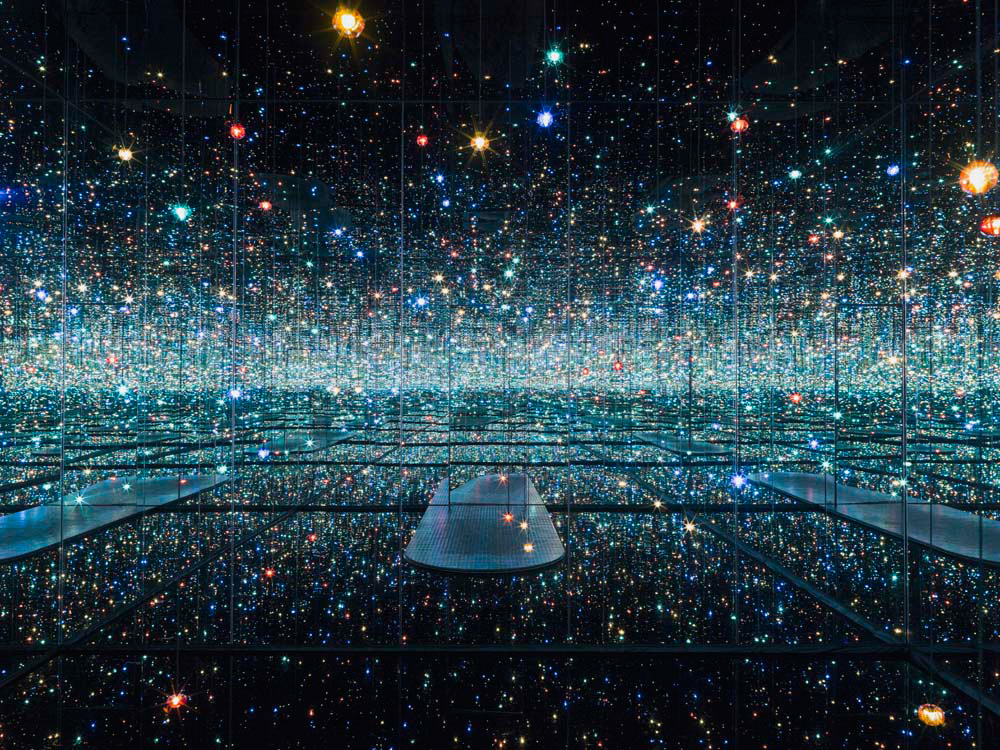
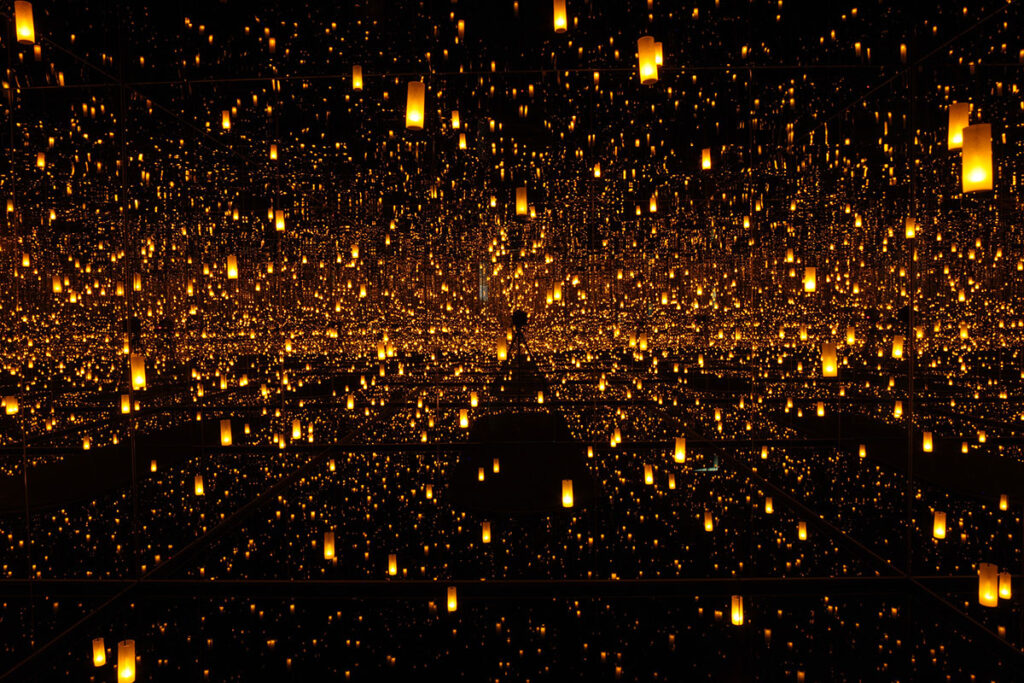
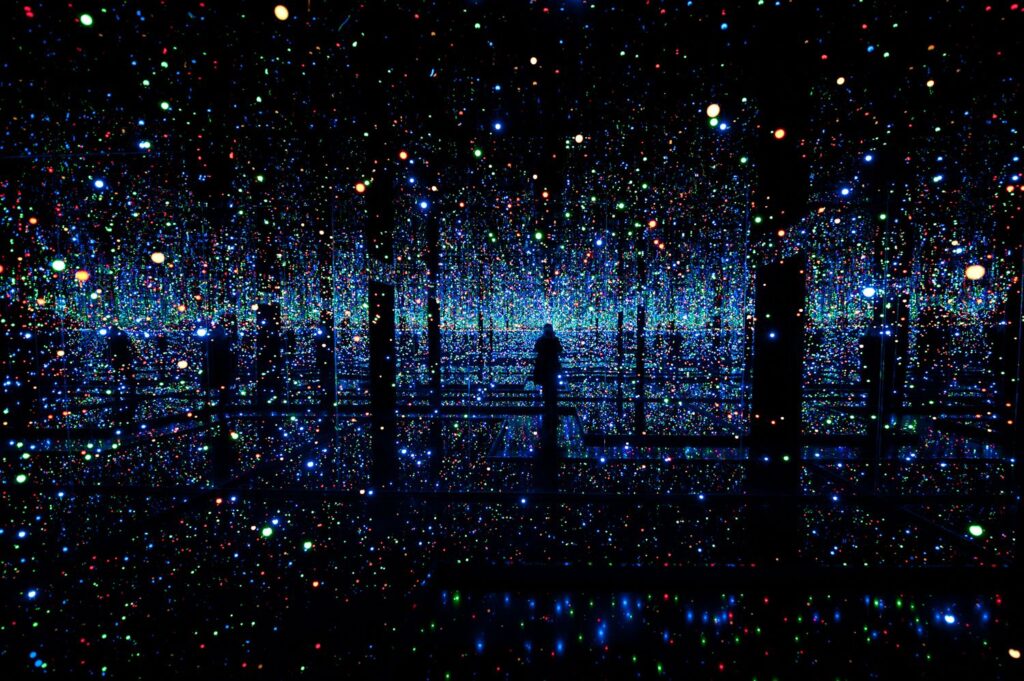
    Yayoi Kusama‘s psychedelic Infinity Mirror Rooms is coming to London. It will be the Tate Modern to showcase the non-place created by the 91-year-old artist for a year. In the last five years, more than five million people around the world have entered her mirror rooms. The exhibition-event was supposed to have opened this year. It was the twentieth anniversary of the museum on the Thames. However, due to the pandemic, it will happen in spring 2021.


    Infinity Mirror Room at the Tate Museum

    The two rooms’ entrance will be “coronavirus-proof”, with staggered entrances with a “virtual row” and, of course, only with a mask. The entry will be one person at a time. This offers visitors the feeling of being completely immersed in infinity.

    infinity mirror rooms

    Despite being a not so large, the Infinity Mirror Rooms – displays the Brilliance of Life is one of Kusama’s largest installations, certainly the most famous. A game of mirrors, lights and water leads to a distant world, suspended on a walkway overlooking the infinite. As always, the time available to everyone will be very short: just 45 seconds of wonder and breathtaking selfies.

    The Chandelier of Grief room will instead be surrounded by crystals. The only source of light in the dark room is a Baroque-style chandelier just above the height of the head.

    Yayoi Kusama, the most loved Japanese artist

    Kusama exhibitions are always successful. Her works are on the market for several million dollars. She is probably the best known and most loved Japanese artist in the world.

    Yayoi Kusama's psychedelic Infinity Mirror Rooms is coming to London. It will be the Tate Modern to showcase the non-place created by the 91-year-old artist for a year.

    But her climb to success has been fraught with incredible difficulties, as extravagant as her artistic nature is.

    Born in 1929, Kusama began painting at the age of 7, coinciding with the emergence of mental and emotional disorders.

    Her complicated inner world evolved in parallel with her growth. At 10 she began to hallucinate, both visual and hearing. She sees an aura around objects, and hears plants and animals speak. From this moment, painting becomes the expressive means to communicate her complicated emotional state to the world.

    Yayoi Kusama, the most loved Japanese artist

    Undoubtedly, one of the themes most dear to Yayoi Kusama is that of infinity. Kusama’s artistic creativity grows and develops in the America of the 50s and 60s, a period in which space research becomes more and more concrete until it reaches the sensational moon landing of 1969. The whole society and culture could not but remain astonished and deeply influenced. Kusama’s response translates into high-level immersive installations.

    The first Infinity Mirror Room by Yayoi Kusama is as innovative as it is provocative: Phalli’s field in fact confronts the theme of sexuality. Inaugurated in New York in 1965, this installation is Kusama’s first expression of overcoming the limits of her own productivity, as it allows her phallic sculptures to extend eternally like an infinite field.

  • Show Me the Monet by Banksy: sold for a record price

    Show Me the Monet by Banksy: sold for a record price

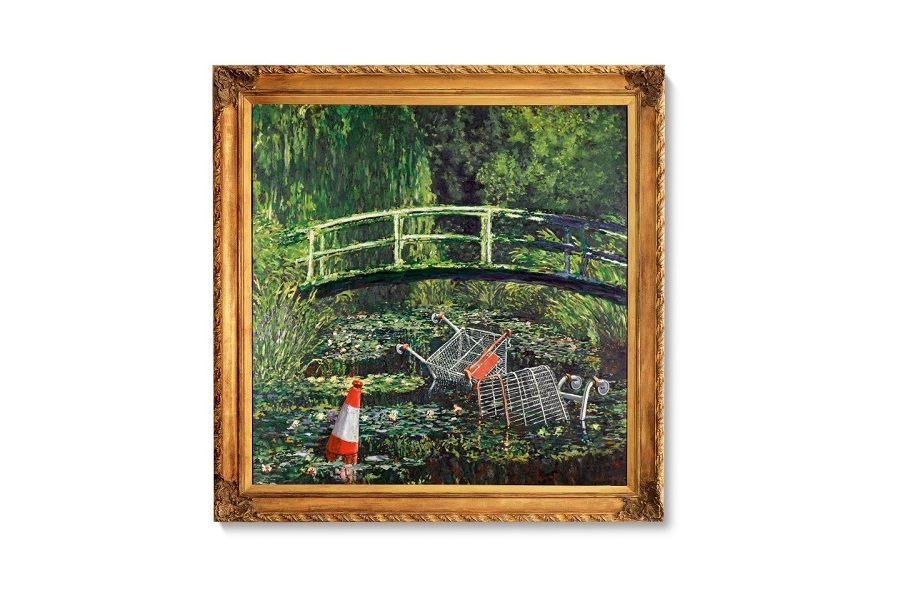
    A record price, 7.6 million pounds – equal to about 8.4 million euros – for Banksy‘s work inspired by Monet. It is “Show Me the Monet,” a tribute by the British street artist to the French impressionist. It was sold at the second-highest price ever paid for a work by Banksy himself.


    The new owner is an anonymous bidder. The painting takes up “Water Lily Pond, Green Harmony” and is an oil on canvas from 2005.

    show me the monet

    The work, in perfect Banksy style, does not lack irony. Unlike the original painting, nature is plenty of shopping trolleys and a traffic cone. A clear reference to consumerism that has contributed to making us increasingly insensitive to the environment.

    The painting is the second most expensive after “Devolved Parliament”, sold at auction for 9.9 million pounds last year.

    Show Me the Monet second-highest price ever paid for a work by Banksy

    The painting is the second most expensive sold after “Devolved Parliament,” which was auctioned for £ 9.9 million last year.

    Banksy wanted in this way to contrast the idyll of Monet’s nature with the symbols of consumerism of today’s society. This also finds a reference in the title. “Show Me the Monet,” in fact, has a very similar sound to “Show me the money,” ie “Show me the money”. The painting, therefore, represents both a tribute to the French artist and a criticism of contemporary disvalues.

    “Here Banksy sheds light on society’s contempt for the environment in favor of the wasteful excesses of consumerism,” explained Sotheby’s European director of contemporary art Alex Branczik.

    His works are real denunciations against the atrocities of war, pollution, the mistreatment of animals and consumerism. The subjects most used by Banksy are monkeys, mice, policemen, but also members of the royal family, cats and children.

    His forays into museums are famous, such as the one at the Metropolitan Museum in New York in 2005. Here he hung a portrait of a lady with a gas mask, in zoos and in Disneyland, where, he introduced a sculpture depicting an inmate of Guantanamo.

    Despite being responsible for some of today’s most recognizable images, we know very little about Banksy, who keeps his identity hidden. His work deals with provocative topics such as capitalism, authority, consumerism, and poverty. These often feature black mice, his trademark. During the early days of the coronavirus pandemic, Banksy encouraged followers to socialize by sharing images of an art installation in his own home. In July, he spray-painted the interior of London Underground carriages with pandemic-themed cartoons, such as rats using face masks as parachutes and holding bottles of hand sanitizer.

Our Content.
Your Inbox

Join thousands of art lovers

Receive art news, market analysis and updates about new artists on the website

By subscribing you agree to receive RDN Arts emails. Unsubscribe at any time. Privacy Policy.